In this article · 9 sections
- What are Alipay, WeChat Pay and bank card in a CNY P2P ad?
- How do you read a USDT P2P ad? The fields explained
- Why is the cheapest ad at the top often not usable?
- What do badges like "verified" and "Top pick" mean?
- What do common remarks in ad terms mean?
- Why do USDT prices differ by payment method?
- What can a P2P ad not tell you?
- Frequently asked questions
- Sources
In a CNY peer-to-peer (P2P) ad for USDT, "Alipay", "WeChat" and "Bank Transfer" are the ways the buyer can pay the seller in yuan. The money never passes through the crypto exchange: the buyer pays the seller directly through Alipay, WeChat Pay or a transfer between Chinese bank accounts, and the exchange releases the seller's USDT from escrow once the seller confirms the yuan has arrived. Each ad also shows a price, the order size it accepts, how much USDT is on offer and a few signals about the seller, and prices differ from one payment method to another.
This guide explains each part of an ad, using real ads from the exchanges' public pages, and why the same coin on the same platform can cost a different amount depending on how you pay. coinkiki's rate page shows one price per exchange and order size across all payment methods, the exchange pages show how many ads accept each method, and the site does not explain how to trade. In mainland China, exchanging yuan for crypto as a business is illegal financial activity; see whether crypto is legal in China.
What are Alipay, WeChat Pay and bank card in a CNY P2P ad?
In China's P2P market the payment methods come down to three rails. The seller, usually a dealer known as a U merchant (U商, U shang), lists which ones they accept, and the buyer must pay through one of them, in their own name.
Bank transfer (银行卡, "bank card")
A transfer between two mainland bank accounts. In Chinese it is usually labelled "bank card" because each personal account comes with a debit card number, and Binance's English pages call it "Bank Transfer". Transfers between Chinese banks are fast, and large amounts generally go this way because the payment apps' own limits are lower.
For foreigners: opening a mainland bank account normally needs a passport, a valid visa or residence status and an in-person visit, and banks set their own conditions. A non-resident outside China typically has no mainland account at all. Bank accounts are also where 冻卡 (dongka, "frozen card") problems hit hardest: if incoming money traces back to fraud, police can freeze the receiving account. See frozen bank cards.
Alipay (支付宝)
Alipay is the payment app run by Ant Group, Alibaba's financial affiliate. Inside China it works as a wallet: users pay by QR code and send money to each other, funded from a linked Chinese bank account or a balance.
For foreigners: Alipay lets overseas visitors link international cards such as Visa and Mastercard, mainly to pay merchants while travelling. In 2024 the authorities raised the single-transaction limit for overseas visitors using mobile payments from USD 1,000 to USD 5,000 and the annual cap from USD 10,000 to USD 50,000. That is a spending tool for visitors. It is not the same as a fully verified mainland account that can receive yuan transfers in a P2P trade.
WeChat Pay (微信支付)
WeChat Pay is the payment function inside WeChat, Tencent's messaging app, and Binance's pages label it simply "WeChat". It works much like Alipay: QR payments, person-to-person transfers, and a balance or linked bank card behind it. Many suppliers and dealers also negotiate in WeChat chats, so it is often both the conversation and the payment.
For foreigners: WeChat Pay also accepts linked international cards under the same visitor limits. The same caution applies: paying for a meal is not the same as receiving a P2P payment.
How do you read a USDT P2P ad? The fields explained
Labels vary by exchange, but most CNY P2P ads show the same information:
| Field | What it means |
|---|---|
| Price | Yuan per 1 USDT. On a "buy USDT" list, lower is better for the buyer; on a "sell USDT" list, higher is better for the seller. |
| Available | How much USDT the advertiser still has on offer. |
| Limit (min to max) | The smallest and largest single order the ad accepts, in yuan. |
| Payment methods | The rails the advertiser accepts. You must pay through one of them. |
| Orders | How many trades the advertiser has completed. Binance and HTX show a recent count; OKX shows lifetime "transactions", so the numbers are not comparable. |
| Completion rate | The share of accepted orders that were finished rather than cancelled or abandoned. |
| Payment window | How long the buyer has to pay after opening an order, often 15 minutes. If the buyer does not mark the order paid in time, it is cancelled and the USDT goes back to the seller. |
| Badges and tags | Labels the exchange gives some advertisers, such as a verified-merchant mark. They are platform labels, not licences. |
| Remarks or terms | Free text from the advertiser, where conditions such as "no third-party payments" appear. |
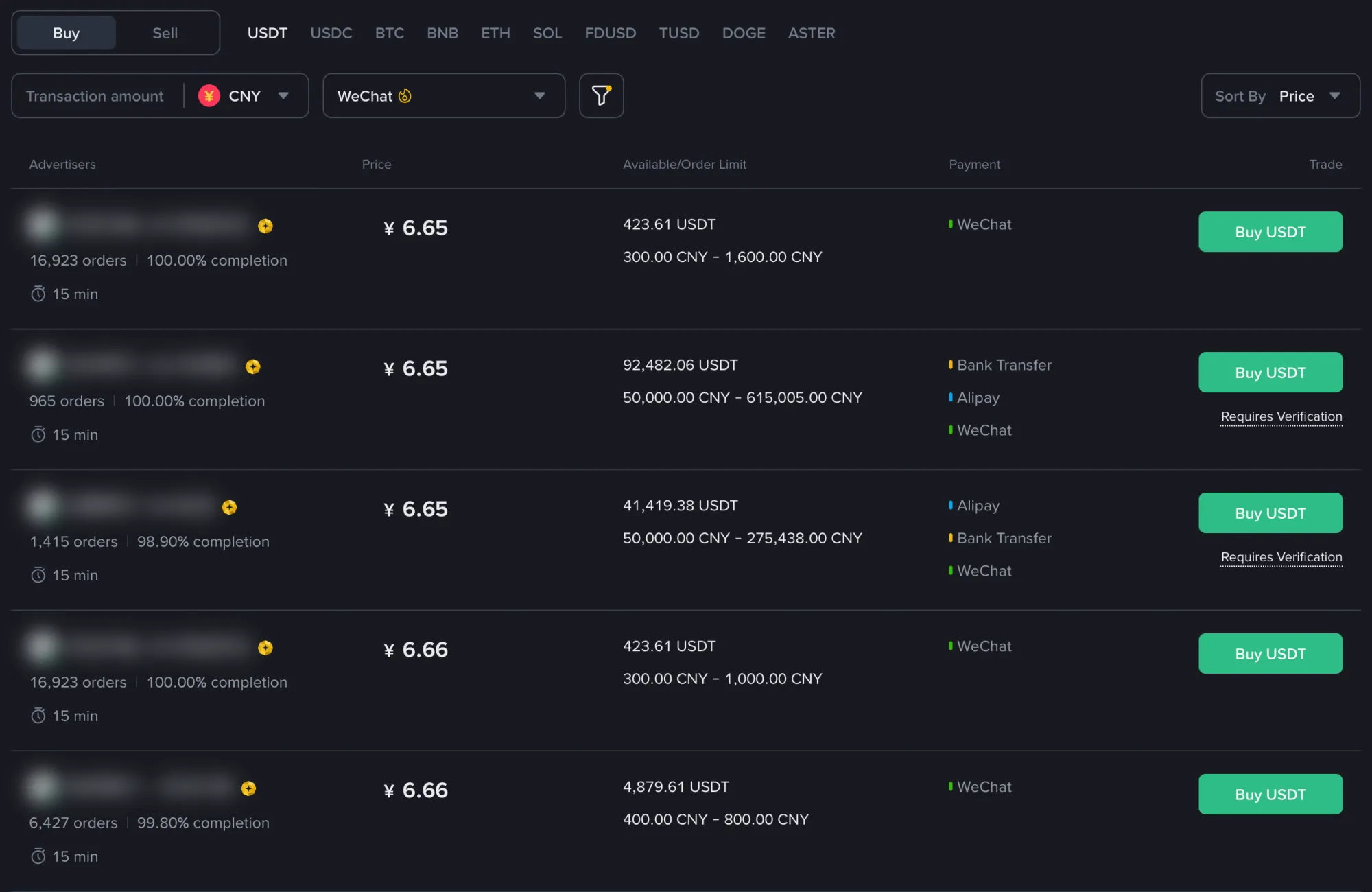
The Binance screenshot below shows several of these fields on real ads filtered for WeChat. The first ad accepts only WeChat and only orders of CNY 300 to 1,600, with 423.61 USDT left. The second accepts all three rails but only orders of CNY 50,000 to 615,005. Both are at CNY 6.65, yet no buyer could use both: one is for small change, the other for a mid-sized transfer.
Why is the cheapest ad at the top often not usable?
Lists are sorted by price, but the top ad may have a high minimum, a tiny maximum, little USDT left or a thin track record. Two checks decide whether an ad can take your order:
- Is your amount inside the limit? An ad limited to CNY 10,000 to 200,000 cannot take a CNY 5,000 order.
- Is there enough USDT? An ad with 500 USDT available cannot fill a CNY 50,000 order at CNY 6.64, because that needs about 7,530 USDT.
A worked example. Say you want to buy USDT with CNY 50,000 and the list shows:
| Ad | Price | Available | Limits | Usable for CNY 50,000? |
|---|---|---|---|---|
| 1 | 6.62 | 1,200 USDT | CNY 500 to 8,000 | No: maximum too low, and too little USDT |
| 2 | 6.63 | 9,000 USDT | CNY 60,000 to 90,000 | No: minimum too high |
| 3 | 6.64 | 20,000 USDT | CNY 30,000 to 150,000 | Yes |
| 4 | 6.64 | 6,000 USDT | CNY 20,000 to 100,000 | No: 6,000 USDT is only about CNY 39,840 |
The first price you could actually get is 6.64, not 6.62. On CNY 50,000, that difference is about 7,530 × 0.02, roughly CNY 150, or 0.3%. This is why coinkiki calculates prices at three order sizes, CNY 5,000, CNY 50,000 and CNY 300,000, using only ads that can take the whole amount from dealers with a completion rate of at least 95% and at least 50 orders, and reports the middle price of the five best. How coinkiki calculates has the details.
What do badges like "verified" and "Top pick" mean?
Exchanges add their own labels to ads. On Binance, a verified-merchant badge appears next to some advertisers, some ads carry a "Requires Verification" note under the buy button, and a highlighted "Promoted Ad" can sit above the ordinary list. HTX shows tags such as "Top pick", "Multi-Auth Account", "Top fill rate", "Over 600 days" and "Night express", and a "No funds verification" note under some advertisers, as in the screenshot below.
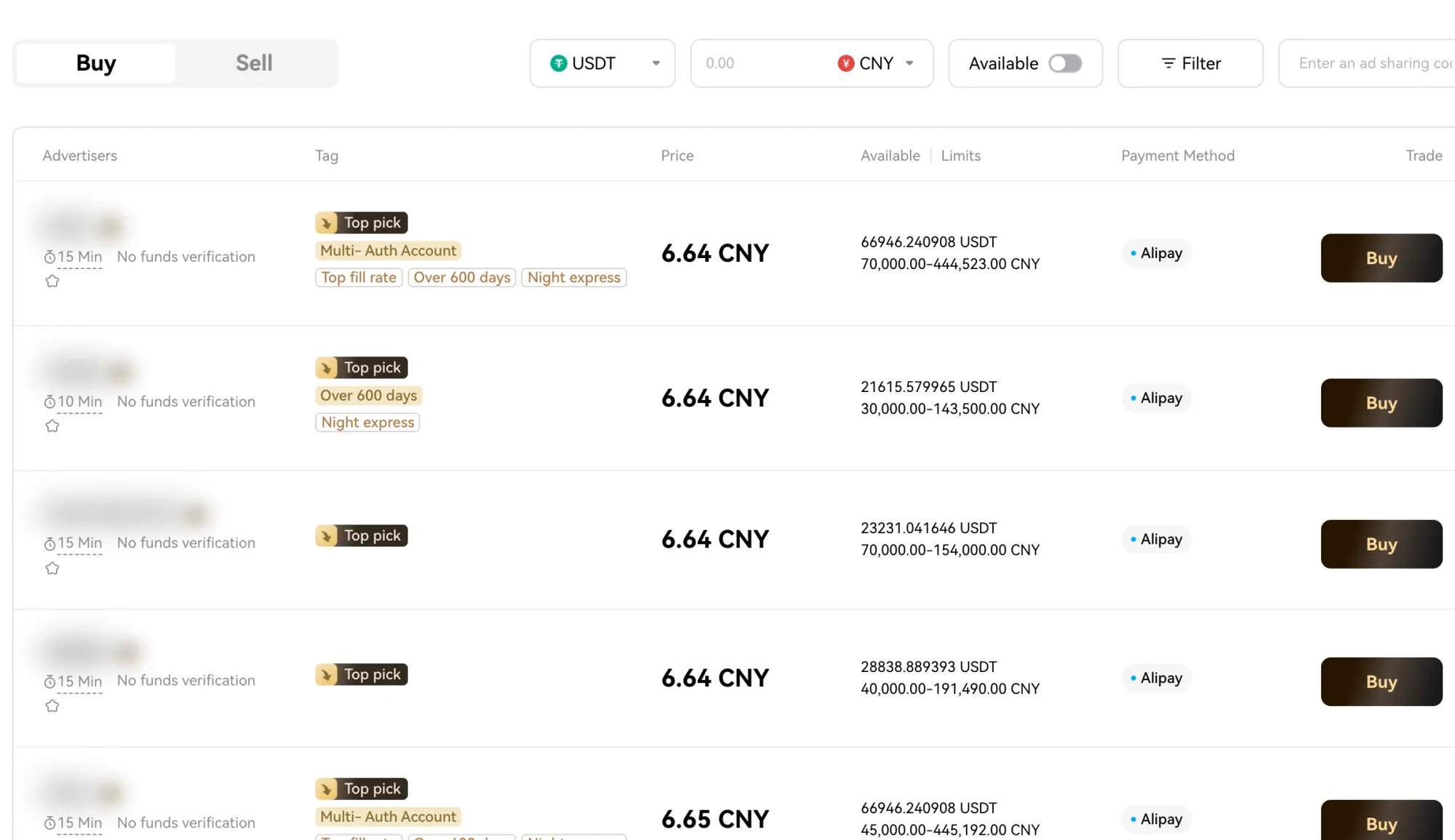
Each exchange defines its labels in its own help pages, and the definitions can change. Read them as the platform's description of an advertiser's history on that platform. None of them is a government licence, and none tells you where the advertiser's coins or yuan came from. A dealer can carry every badge and still receive money that traces back to a scam.
What do common remarks in ad terms mean?
"No third-party payments" (不接受第三方付款)
The money must come from an account in the buyer's own name, the same person who opened the order on the platform. A payment from a friend, a company account or someone else's phone counts as third-party. Sellers insist on this because third-party money is how fraud proceeds usually enter P2P trades: a scammer tricks a victim into paying the seller, takes the USDT, and the victim's bank later traces the payment to the seller's account.
"Real-name match" (实名一致)
The name on the paying account must match the name verified on the platform. Sellers check it in their banking or wallet app before releasing USDT, and a mismatch usually ends in cancellation or a dispute. China's anti-fraud law bans renting, lending or selling bank and payment accounts and helping others pass real-name checks, which is why sellers treat a mismatch as a red flag.
Other terms you may see
- "Do not write crypto-related notes": some ads ask buyers not to mention USDT or crypto in the transfer memo. It shows the seller knows banks screen for crypto activity. It does not make the trade any less illegal, and coinkiki does not advise following it.
- "Pay within X minutes, release after arrival": a reminder of the payment window, and that the seller releases USDT only after seeing the money.
- "Large orders, contact first": the advertiser wants to agree large trades in chat first, often because of bank limits or freeze risk.
Why do USDT prices differ by payment method?
The same exchange at the same moment can show one price for Alipay ads and another for WeChat or bank-transfer ads. On 10 November 2026, for example, the cheapest ordinary Alipay ads on Binance were at CNY 6.63 to 6.64, while ads filtered for WeChat started at 6.65. Reasons include:
- Different freeze risk. Each rail has its own monitoring and its own way of handling complaints, and sellers price in how likely a trade is to end in a frozen account.
- Different limits. Wallet apps cap transfers more tightly than banks, so large orders mostly run on bank rails and draw a different set of advertisers.
- Different crowds. Small retail buyers often prefer the apps for convenience, while larger dealers work through banks. Each pool settles on its own price.
- Convenience. Sellers can ask more on a rail buyers find easier, or offer a better price on a rail they prefer to receive on.
A gap of 0.02 yuan sounds small, but on a CNY 300,000 order it is about 900 yuan. coinkiki's prices combine all payment methods, so a gap like this does not show up as a separate number. What the exchange pages for Binance, OKX and HTX do show is how many medium-size ads accept bank transfer, Alipay and WeChat Pay on each side and each method's share of the buy-side ads, which tells you which rails most dealers are using at the moment. The gap between the P2P price and the official rate is tracked on the USDT premium page. Why that gap exists is explained in why USDT trades above or below the dollar.
What can a P2P ad not tell you?
- Whether the money is clean. A completion rate and an order count describe past behaviour on the platform, not where the coins or the yuan came from. Tainted USDT is called 黑U (hei U, "black U").
- Whether the account will be frozen later. Freezes can come weeks after a trade.
- Whether the trade is legal. In mainland China it is not. For anyone outside China, local rules on crypto, sanctions, tax and anti-money-laundering apply, and you should take advice in your own country.
The risk page collects these issues in one place, and our glossary explains other terms that appear in ads and chats.
Frequently asked questions
Can a foreigner pay a P2P ad with Alipay or WeChat Pay linked to a foreign card?
The visitor versions of these apps are designed for paying merchants, with limits of USD 5,000 per transaction and USD 50,000 a year. Sellers also require the payer's name to match the verified account on the exchange. A foreign-card wallet is not the same as a mainland account that receives and sends yuan transfers.
Is bank transfer safer than Alipay or WeChat Pay in a P2P trade?
No rail is safe from freezes. Bank transfers carry the larger sums and are where police freezes most often land; the payment apps have their own monitoring and limits. The risk comes mostly from where the money came from, not from the rail.
What happens if the buyer does not pay within the payment window?
The order is cancelled and the seller's USDT is released back to the seller. A buyer who has already paid but forgot to mark the order as paid has to raise a dispute with the exchange.
What is the "Promoted Ad" at the top of a P2P list?
It is an ad the exchange displays in a highlighted box above the ordinary, price-sorted list. It is not necessarily the best price: on 10 November 2026 Binance's promoted CNY ad was at 6.71 while the ordinary ads below it started at 6.63. Compare it with the ads underneath before treating it as the going rate.
Does a verified-merchant badge mean the dealer is licensed?
No. It is a platform label. No one is licensed to exchange yuan for crypto in mainland China.
Sources
- Xinhua via gov.cn, China further streamlines mobile payments for foreigners, 11 April 2024: english.www.gov.cn
- PBoC et al., Yinfa [2026] No. 42, 6 February 2026: pbc.gov.cn
- Anti-Telecom and Online Fraud Law of the PRC, Article 31, full text as reprinted by The Paper: thepaper.cn
- Binance P2P, CNY ads for USDT filtered for WeChat (public page): p2p.binance.com
- HTX P2P, CNY ads for USDT (public page): htx.com