In this article · 10 sections
- What is the USDT premium in China?
- How is the USDT/CNY premium calculated?
- Which official rate? The central parity, CNY and CNH
- Why is USDT more expensive than the dollar in China?
- How much of the premium is the price of risk?
- Why is USDT sometimes cheaper than the dollar in China?
- Does the premium differ by order size and payment method?
- What the USDT premium can and cannot tell you
- Frequently asked questions
- Sources
USDT is designed to be worth one US dollar, but in China's peer-to-peer (P2P) market its yuan price is rarely the same as the official dollar rate. When buyers pay more yuan for USDT than for a dollar, USDT trades at a premium; when they pay less, at a discount. The gap exists because the yuan's dollar rate is managed and the amount of dollars a person can buy is capped, while USDT changes hands in an informal market where every trade carries legal and banking risk. Demand to move money out pushes the price up; sellers who need yuan, and the risk of tainted coins, push it down.
| Order of | Highest sell | Lowest buy |
|---|---|---|
| CNY 5,000Small | 6.620Binance | 6.640Binance |
| CNY 50,000Medium | 6.630Binance | 6.630Binance |
| CNY 300,000Large | 6.640Binance | 6.630Binance |
Live data, CNY per USDT · updated 20:00 Beijing time · premium −0.85% · full board
Today's figure and its history are on the China USDT premium page. This guide explains what the number measures, which official rate it is compared with, and what moves it.
What is the USDT premium in China?
The premium is the gap between two prices for what is meant to be the same thing, a US dollar:
- the yuan price of one USDT on China's P2P boards, where dealers known as U merchants (U商, U shang) sell USDT to buyers who pay them by bank transfer, Alipay (Ant Group's payment app) or WeChat Pay (the payment function in Tencent's WeChat); and
- the yuan price of one dollar in the regulated currency market.
On 10 November 2026, for example, the official USD/CNY central parity was 6.7167, while the cheapest ordinary ads selling USDT for yuan on Binance, OKX and HTX were at CNY 6.63 to 6.64. At 6.64, USDT was about 1.1% cheaper than the dollar: a discount. At other times the same comparison has shown USDT costing more than the dollar. The sign and size of the gap change with market conditions, which is why coinkiki tracks it every 3 minutes rather than quoting a fixed number.
How is the USDT/CNY premium calculated?
coinkiki uses this formula:
premium = (lowest medium-size buy price − USD/CNY reference) ÷ USD/CNY reference
- Medium-size buy price: the yuan you would pay per USDT for an order of about CNY 50,000, taken as the middle price of the five best ads that could take an order that size, from dealers with a completion rate of at least 95% and at least 50 orders. The lowest of the three exchanges' prices is used. A medium size is used because the very cheapest ads often cannot take a normal order. How coinkiki calculates gives the full method.
- USD/CNY reference: a daily market rate for the onshore yuan against the dollar.
Worked examples, all against a reference of 6.72:
| USDT buy price (CNY) | Calculation | Premium |
|---|---|---|
| 6.64 | (6.64 − 6.72) ÷ 6.72 | −1.19% (discount) |
| 6.72 | (6.72 − 6.72) ÷ 6.72 | 0.00% |
| 6.79 | (6.79 − 6.72) ÷ 6.72 | +1.04% |
| 6.92 | (6.92 − 6.72) ÷ 6.72 | +2.98% |
A positive number means USDT is dear in yuan terms and a negative number means it is cheap. coinkiki also shows the same calculation for the sell side, using the highest medium-size sell price, because that is what someone converting USDT back into yuan receives.
Which official rate? The central parity, CNY and CNH
The yuan has more than one dollar price, and they are easy to mix up.
Onshore CNY and the central parity rate
CNY is the yuan traded inside mainland China, mainly on the interbank market run by the China Foreign Exchange Trade System (CFETS). Each business day CFETS, authorised by the People's Bank of China (PBoC), publishes the central parity rate (中间价, zhongjianjia), often called the "fixing". CFETS describes the method on its website: before the market opens it asks every market maker for a quote, "excludes the highest and lowest offers", and takes a weighted average of the rest, with weights based on each market maker's trading volume and market-making performance.
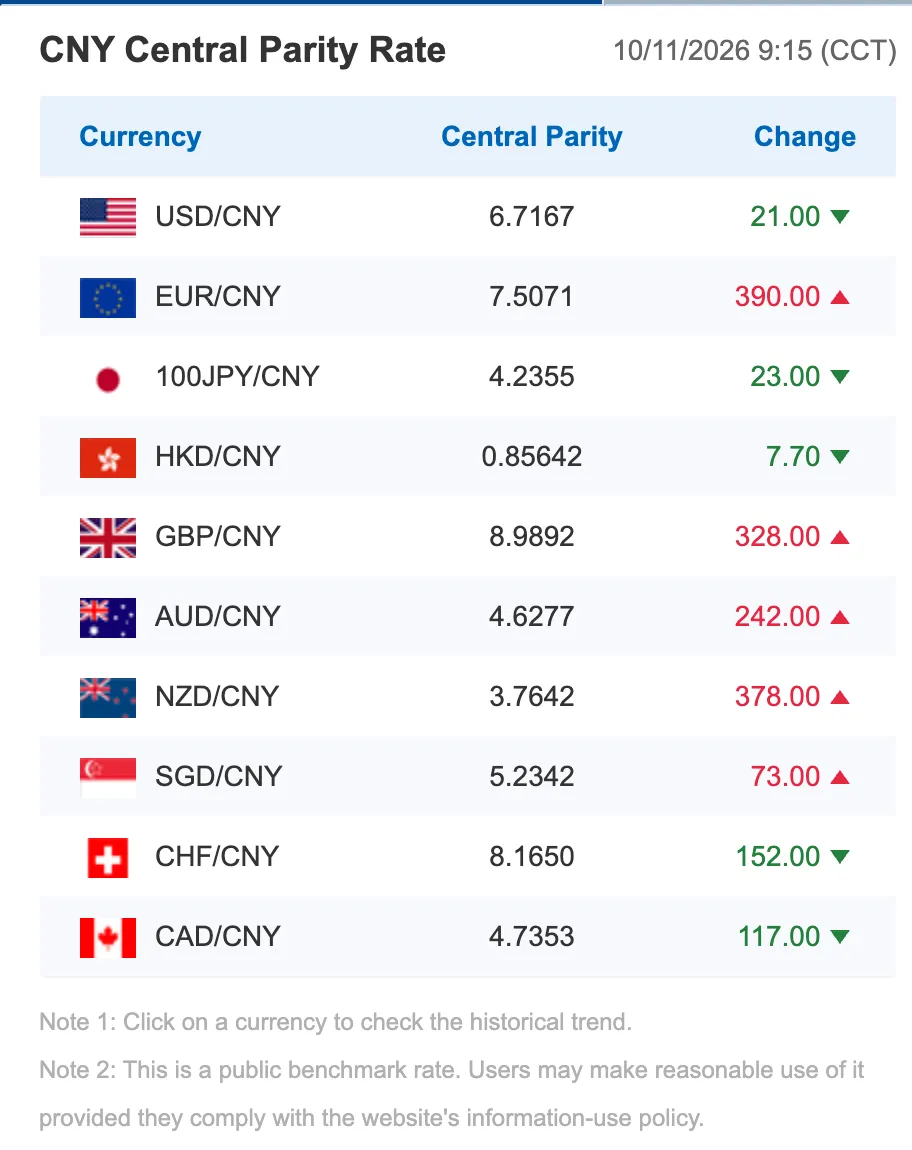
Onshore spot trading may then move only within a band around the parity. The PBoC widened the band for the yuan against the dollar on the interbank spot market from 1% to 2% either side with effect from 17 March 2014, the third widening since the 2005 exchange-rate reform, according to People's Daily. With a parity of 6.7167, a 2% band means onshore spot trades that day had to stay between about 6.5824 and 6.8510.
Offshore CNH
CNH is the same currency traded outside the mainland, mostly in Hong Kong. Its rate is set by trading there, so it can differ from the onshore rate. Usually the two are close, but in periods of stress the gap can widen.
Why the choice of reference matters
A premium measured against the central parity is not the same as one measured against CNH or against a market close. If the offshore yuan is weaker than the onshore yuan on a given day, part of what looks like a USDT premium over CNY is really the onshore-offshore gap. coinkiki's reference is a daily market rate from ExchangeRate-API, not the CFETS parity, and it is shown on the page next to the premium so you can compare like with like. Note also that the parity is set once per business day, while P2P ads change around the clock, weekends included. On a Sunday, the reference is still the last business day's rate.
Why is USDT more expensive than the dollar in China?
When USDT trades at a premium, the main reason is that dollars are hard to obtain legally in large amounts.
The USD 50,000 annual quota
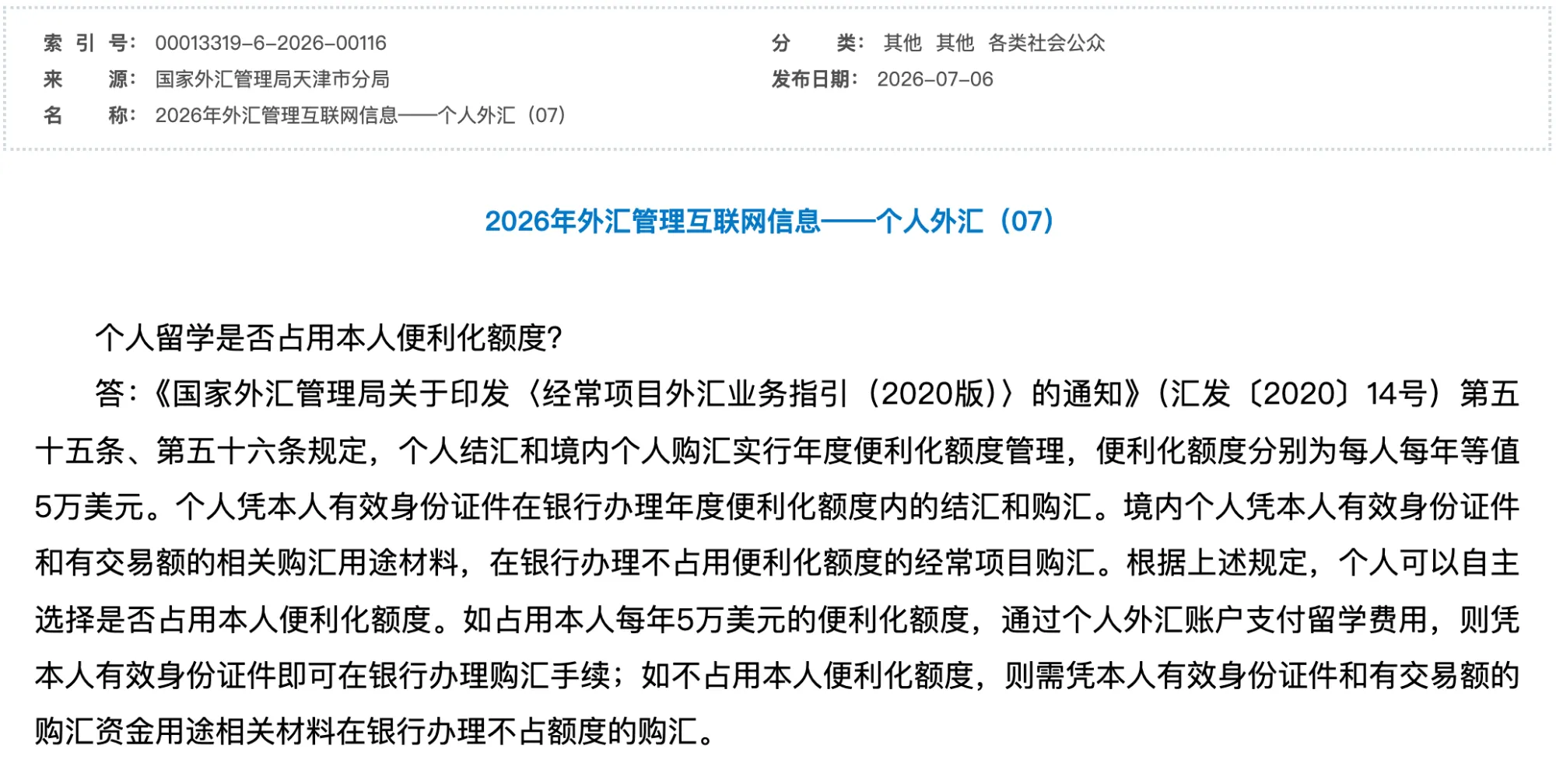
The State Administration of Foreign Exchange (SAFE), which runs China's currency controls, gives each individual an annual allowance, now called the "facilitation quota" (便利化额度), equivalent to USD 50,000 for buying foreign currency and the same again for selling it. Within the quota a person can buy dollars at a bank with just an ID card. Beyond it, purchases for current-account purposes such as tuition or travel need documents showing what the money is for. The limit comes from Article 2 of SAFE's 2007 implementing rules for individual foreign exchange, which set an annual total of USD 50,000 per person, and it is restated in Articles 55 and 56 of SAFE's 2020 current-account guidelines (Huifa [2020] No. 14). Capital-account uses, such as buying property or shares abroad, fall under separate and tighter rules.
Across the market, the effect works through aggregate demand. The bank channel is capped per person and needs paperwork above the quota, while demand for dollar holdings from people in China (for savings, overseas spending or hedging against a weaker yuan) does not stop at that line. Part of that demand ends up on the P2P boards, where USDT trades as a dollar substitute that is not counted against any quota. When that demand rises, for example when the yuan is weakening, more buyers compete for the same dealers' coins, sellers raise their prices, and the premium widens. When it eases, or when exporters who were paid in USDT need yuan, the premium narrows or turns into a discount. A premium of 2% means the market as a whole is paying about CNY 6.85 for one USDT when the parity is 6.7167.
Buying USDT this way is not legal. Under the PBoC's February 2026 notice (Yinfa [2026] No. 42), exchanging yuan for crypto is illegal financial activity in mainland China, and the notice names Tether's coin (泰达币) alongside bitcoin and ether as having no legal tender status. In a typical case issued in December 2023 by the Supreme People's Procuratorate and SAFE, using USDT as a bridge between foreign currency and yuan was treated as disguised foreign exchange trading and punished as the crime of illegal business operation. See whether crypto is legal in China.
How much of the premium is the price of risk?
Even without demand to move money abroad, a dealer wants to be paid for the risks of each trade:
- Frozen bank cards. A dealer who receives yuan from a buyer whose money traces back to fraud can have the account frozen by police in another province, a problem known as 冻卡 (dongka, "frozen card"). See frozen bank cards.
- Legal exposure. Dealers who trade often are exactly the kind of business the notices ban, and those who move fraud money can be prosecuted.
- Disputes. Any trade can end in a payment dispute that the exchange has to settle, tying up USDT for days.
Dealers price these risks into the gap between their buying and selling prices. The 2023 case gives one documented figure: the group earned "more than 2%" per transaction from the rate difference, and on CNY 43.85 million of exchanges it made about CNY 870,000, close to 2%. That is one criminal group's margin, not a market average, but it shows the order of magnitude.
Why is USDT sometimes cheaper than the dollar in China?
A discount means that, at the official rate, more people want to sell USDT for yuan than to buy it. Common reasons:
- Sellers who need yuan. A Chinese exporter or trader paid in USDT has wages, rent and suppliers to pay in yuan and may accept a lower price to sell quickly. Trade money really does run through this market: in the 2023 case, prosecutors checked 15 of the group's transactions and the people in China who received the yuan said it was payment from abroad for foreign-trade business.
- Tainted coins. USDT that may come from fraud or gambling, called 黑U (hei U, "black U"), is risky to accept. Buyers demand a discount for it, and sellers who need to get rid of it may accept one. An ad does not tell you which coins you are dealing with.
- Crackdowns. When enforcement tightens, fewer people want to buy and hold USDT, and dealers compete for the remaining buyers.
- Dollar moves. If the yuan strengthens sharply against the dollar, P2P prices can lag the reference for a while, and the reverse.
For a supplier, a discount is a real cost. If an importer sends 10,000 USDT and the supplier sells it at 6.63, the supplier receives CNY 66,300. The same USD 10,000 converted at the 6.7167 parity would be CNY 67,167, a difference of CNY 867, or about 1.3%, before any bank charges on either route. Our comparison of USDT, bank wires and payment agents sets this against the fees and spreads of a wire.
Does the premium differ by order size and payment method?
Yes. There is no single P2P price, even on one exchange:
- Order size. coinkiki shows three sizes: CNY 5,000, CNY 50,000 and CNY 300,000. Fewer dealers can fill a CNY 300,000 order, and large transfers draw more attention from banks, so large orders can be priced less favourably, though not always.
- Payment method. Ads accept bank transfer, Alipay or WeChat Pay. Each has its own limits, freeze risk and convenience, so each settles at its own price. See what P2P ad terms mean.
- Exchange. Binance, OKX and HTX each have their own pool of dealers. coinkiki shows them side by side on the rate page without ranking them.
The headline premium uses the medium size and all payment methods, so that it can be compared from day to day.
What the USDT premium can and cannot tell you
It can tell you:
- roughly how many extra yuan, or how many fewer, a buyer pays for a "digital dollar" compared with the official rate;
- whether pressure is building or easing over weeks and months, from the daily history.
It cannot tell you:
- what price you will get, since ads change every few minutes;
- whether a counterparty is safe, since a good price can come with tainted coins or a freeze-prone account;
- anything about legality, which a price does not change.
For a supplier payment, the premium is one input among several. The USDT vs wire calculator puts it next to bank-wire costs, and the risk page covers what the numbers leave out.
Frequently asked questions
Why is USDT cheaper in China than the dollar right now?
When USDT trades at a discount, sellers who need yuan outnumber buyers at the official rate. Typical causes are exporters and traders converting USDT income, dealers offloading coins they consider risky, and periods of tighter enforcement. On 10 November 2026 the best P2P ads were about 1% below the central parity.
Is a high premium a sign of capital flight?
It is a sign that demand for dollar substitutes inside China is strong relative to supply, and moving money abroad beyond the USD 50,000 quota is one source of that demand. It is not proof on its own: freeze risk, enforcement and the dollar's own moves also shift the price.
Which rate should I compare USDT with, CNY or CNH?
For money that ends up inside mainland China, the onshore CNY rate and its central parity are the usual benchmark. CNH matters for money held offshore. coinkiki shows both reference rates so you can see how much of a gap comes from the onshore-offshore difference.
Does the premium include fees?
No. It compares ad prices with the reference rate. Network fees for sending USDT, bank charges and any fee an agent adds come on top.
Why does the premium change at weekends when the official rate does not?
The central parity is set once per business day, while P2P ads keep changing. On weekends and holidays every move in the premium comes from the P2P side.
Sources
- CFETS, CNY central parity rate and description of the method: chinamoney.com.cn
- People's Daily, PBoC widens the yuan's trading band against the dollar to 2% from 17 March 2014, 16 March 2014: people.com.cn
- SAFE, Implementing Rules for the Administration of Individual Foreign Exchange (2007), Article 2: safe.gov.cn
- SAFE Tianjin Branch, personal FX Q&A citing Huifa [2020] No. 14, Articles 55 and 56, 6 July 2026: safe.gov.cn
- PBoC et al., Yinfa [2026] No. 42, 6 February 2026: pbc.gov.cn
- SPP and SAFE, typical cases on foreign exchange crimes, 11 December 2023 (PDF): safe.gov.cn
- ExchangeRate-API, free open-access service documentation: exchangerate-api.com