In this article · 10 sections
- Is buying or selling USDT legal in mainland China?
- What did the 2021 notice, Yinfa [2021] No. 237, ban?
- What does the 2026 notice, Yinfa [2026] No. 42, add?
- Are crypto contracts enforceable in Chinese courts?
- How do Chinese prosecutors treat USDT trades?
- What does this mean for foreign companies paying Chinese suppliers?
- Can foreigners in China trade USDT legally?
- Is crypto legal in Hong Kong?
- Frequently asked questions
- Sources
No. In mainland China, crypto business is illegal. Exchanging yuan for crypto, swapping one crypto for another, acting as a counterparty and matching buyers and sellers are all "illegal financial activity" under a notice issued on 6 February 2026 by the People's Bank of China (PBoC) and seven other agencies, which names Tether's USDT alongside bitcoin and ether and replaced a similar 2021 ban. Offshore platforms may not serve people in mainland China, and when an investment in crypto "violates public order and good morals" the contract is void and the investor bears the loss. Hong Kong is a separate legal system and now licenses some stablecoin issuers.
This is not legal advice.
This guide sets out what each notice says, how courts and prosecutors have applied the rules to USDT, and what it means for companies and people outside China who deal with mainland counterparties. We quote or paraphrase only provisions we have read in the official text, and translations are our own. For what this means for a USDT payment to a supplier, see the risks for buyers.
Is buying or selling USDT legal in mainland China?
The current rules are administrative notices from China's financial regulators. They are not a criminal statute, but they define which activities count as "illegal financial activity", tell banks, payment companies and internet platforms what they may not do, and point to the Criminal Law for serious cases. The key points for USDT:
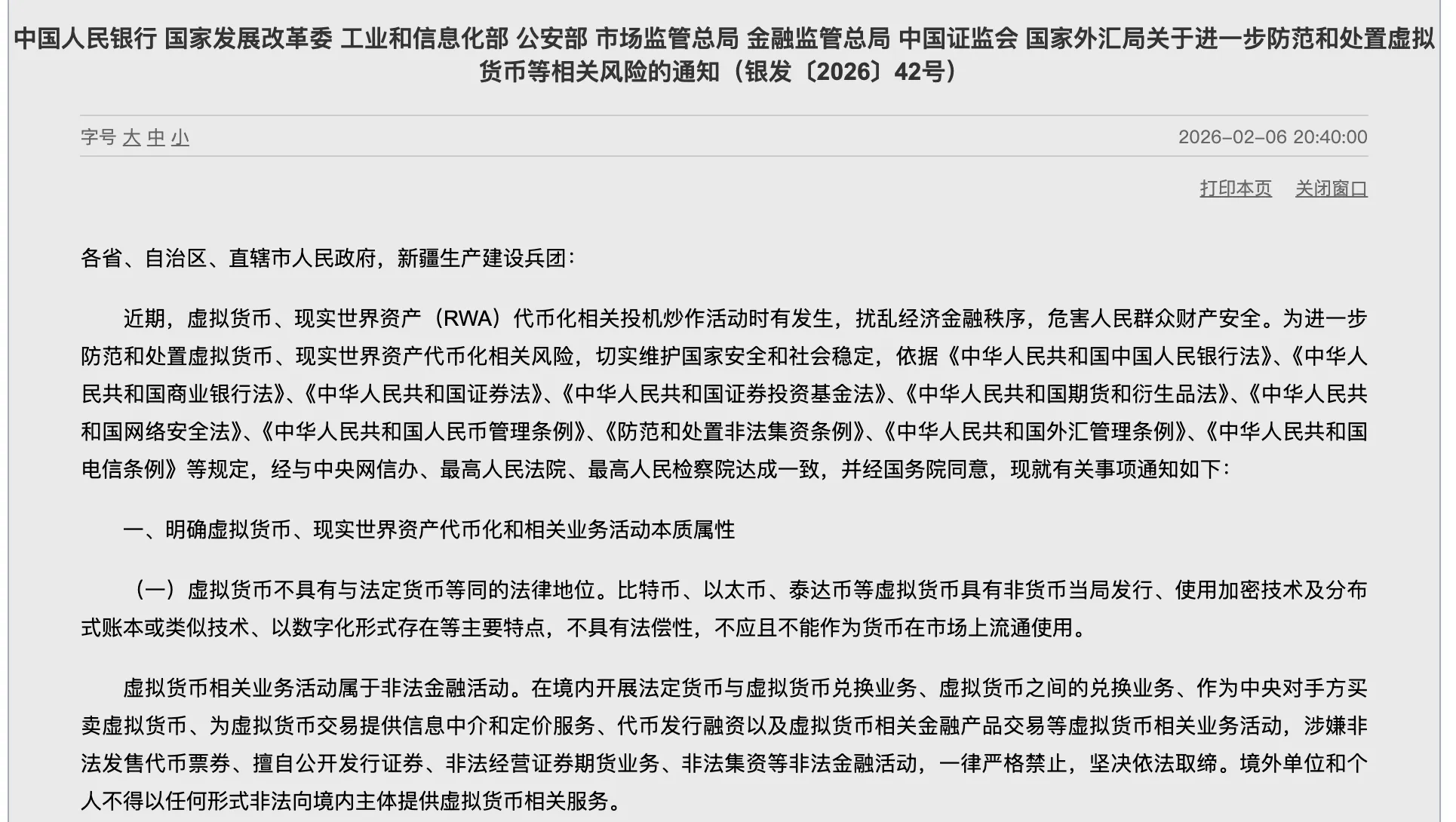
- USDT is named. The 2026 notice says bitcoin, ether and 泰达币 (taidabi, the Chinese name for Tether's USDT) "do not have legal tender status" and "should not and cannot circulate as currency in the market".
- Trading it for yuan as a business is banned. Exchanging fiat money for virtual currency inside China is listed first among the banned activities. That is exactly what a CNY peer-to-peer (P2P) trade does: one side pays yuan by bank transfer, Alipay (Ant Group's payment app) or WeChat Pay (Tencent's), and the other releases USDT.
- The people who make the market are the target. Dealers known as U merchants (U商, U shang) and settlement desks known as 承兑 (chengdui, "acceptance") buy and sell USDT for yuan as a business. Their activity is what the notices call illegal financial activity.
- Investors are on their own. The notices declare investment contracts void where they violate public order and good morals, so a person who loses money has little legal protection.
The notices do not contain a provision that makes merely holding crypto an offence. Whether a particular person's conduct is lawful depends on what they did, how often and with whom, which is a question for a lawyer.
What did the 2021 notice, Yinfa [2021] No. 237, ban?
On 15 September 2021, ten bodies signed the Notice on Further Preventing and Handling the Risks of Virtual Currency Trading and Speculation (关于进一步防范和处置虚拟货币交易炒作风险的通知, Yinfa [2021] No. 237). The PBoC published it on 24 September 2021. The signers were the PBoC, the Cyberspace Administration, the Supreme People's Court, the Supreme People's Procuratorate, the Ministry of Industry and Information Technology, the Ministry of Public Security, the State Administration for Market Regulation, the banking and insurance regulator, the securities regulator, and SAFE (the State Administration of Foreign Exchange, which runs China's currency controls).
Its core points:
- No legal tender status. Virtual currency does not have the same legal status as fiat money.
- Business activity is illegal financial activity. The notice listed fiat-to-crypto exchange, crypto-to-crypto exchange, buying and selling as a central counterparty, providing information-matching or pricing services, token issuance financing and crypto derivatives trading.
- Offshore exchanges included. An offshore exchange that serves mainland residents over the internet is also carrying on illegal financial activity, and its staff in China, and anyone who knowingly provides it with marketing, payment or technical services, are to be held liable.
- Civil acts void. When anyone invests in virtual currency or related derivatives in a way that violates public order and good morals, the civil juristic act is void and the investor bears any loss.
- Enforcement campaigns. The police were told to continue campaigns against money laundering, cross-border gambling and the "card-breaking" campaign against rented-out bank and phone accounts.
What does the 2026 notice, Yinfa [2026] No. 42, add?
On 6 February 2026, eight agencies issued the Notice on Further Preventing and Handling Risks Related to Virtual Currency and Other Matters (关于进一步防范和处置虚拟货币等相关风险的通知, Yinfa [2026] No. 42). The signers were the PBoC, the National Development and Reform Commission, the Ministry of Industry and Information Technology, the Ministry of Public Security, the State Administration for Market Regulation, the National Financial Regulatory Administration, the China Securities Regulatory Commission and SAFE. The preamble says it was agreed with the Cyberspace Administration, the Supreme People's Court and the Supreme People's Procuratorate and approved by the State Council. It took effect on the day it was issued, and its closing provision repeals the 2021 notice.
2021 and 2026 notices compared
| Yinfa [2021] No. 237 | Yinfa [2026] No. 42 | |
|---|---|---|
| Issued by | 10 bodies, including the courts and prosecutors | 8 agencies, agreed with the courts and prosecutors, approved by the State Council |
| Coins named | Bitcoin, ether, Tether | Bitcoin, ether, Tether |
| Banned business | Fiat-crypto and crypto-crypto exchange, central counterparty, matching and pricing, token issuance, derivatives | The same list, "inside China", with "virtual-currency-related financial products" in place of derivatives |
| Offshore providers | Serving mainland residents online is illegal financial activity | May not "in any form" illegally provide services to parties in China |
| Stablecoins | No specific provision | No one may issue a yuan-pegged stablecoin abroad without approval |
| Real-world asset tokens | Not covered | Banned inside China unless approved and run on designated infrastructure |
| Banks and payment firms | No accounts, transfers or clearing for crypto business | The same, plus no issuing or selling crypto-related financial products |
| Company names | No "virtual currency", "virtual assets", "crypto currency", "crypto assets" | Adds "stablecoin", "real-world asset tokenization" and "RWA" |
| Contracts | Void if against public order and good morals | The same, extended to real-world asset tokens |
Crypto business remains banned (Part I, item 1)
The notice again calls virtual currency business activity illegal financial activity. It lists, for activity carried on inside China: exchanging fiat money for virtual currency; exchanging one virtual currency for another; buying and selling as a central counterparty; providing information-matching and pricing services; token issuance financing; and trading virtual-currency-related financial products. It says these may amount to illegal sale of token certificates, unauthorised public securities offerings, illegal securities and futures business or illegal fundraising, and that they are "strictly prohibited" and will be "resolutely banned according to law".
Offshore providers may not serve the mainland (Part I, items 1 and 2)
Offshore entities and individuals "may not, in any form," illegally provide virtual currency services to parties inside China. A parallel sentence covers services for real-world asset (RWA) tokenization, which turns ownership or income rights in an asset into tokens.
Yuan-pegged stablecoins (Part I, item 1)
The notice says fiat-pegged stablecoins in effect perform some functions of legal tender in circulation. Without approval from the relevant authorities, no entity or individual, in China or abroad, may issue a stablecoin pegged to the yuan outside China. Separately, item 13 says mainland entities and the offshore entities they control may not issue virtual currency abroad without approval.
Banks, payment firms and internet platforms (Part III, items 6 and 7)
Financial institutions, including non-bank payment institutions such as the companies behind Alipay and WeChat Pay, may not open accounts, transfer funds, or clear and settle payments for virtual currency business. Internet companies may not provide online business premises, commercial display, marketing or paid traffic for virtual currency or RWA business. These rules are the background to bank accounts used for P2P trades being frozen or restricted; see frozen bank cards in China's OTC market.
Penalties, including for people who help (Part VI, item 18)
Anyone who carries on these activities, or provides services to them, is to be penalised under the relevant rules, and conduct that amounts to a crime is prosecuted. An entity or individual in China who knows, or should know, that an offshore party is illegally serving mainland users and still assists it will be held liable, and prosecuted if the conduct is criminal.
Are crypto contracts enforceable in Chinese courts?
Item 19 of the 2026 notice is the provision that matters most for contracts. It reads, in our translation:
Where any entity or individual invests in virtual currency, real-world asset tokens or related financial products in violation of public order and good morals, the relevant civil juristic acts are void, and any resulting loss is borne by that party.
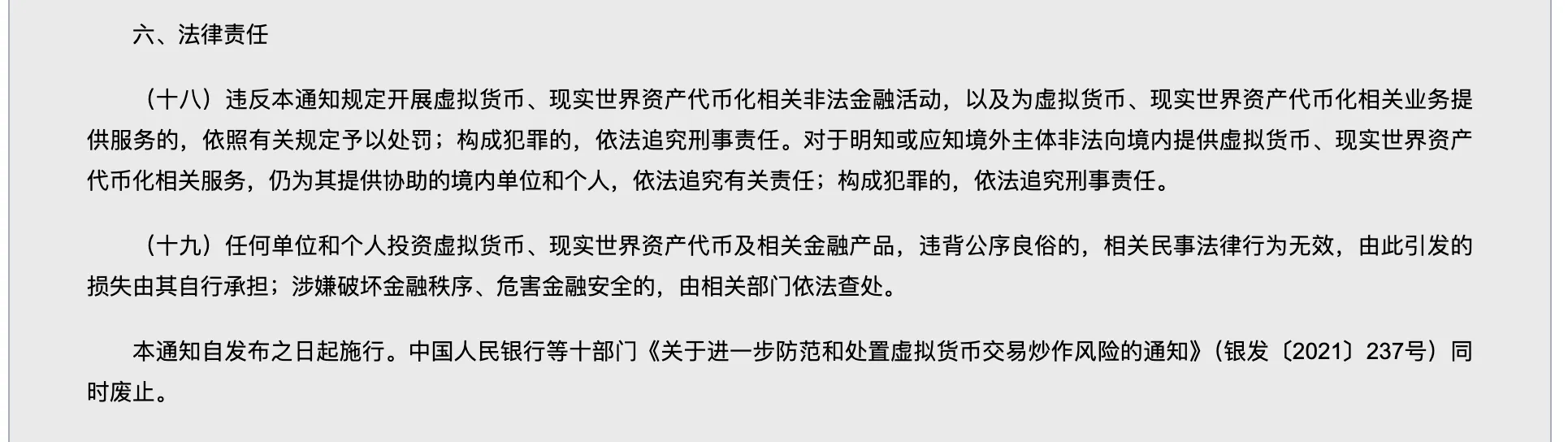
The wording is about investment, and how a court treats a contract for goods that happens to be paid in USDT depends on the facts. But the direction is clear. A party who goes to a mainland court to recover crypto, or to enforce a promise made in crypto, should expect the court to question whether the arrangement is valid at all, and to leave losses where they fell.
How do Chinese prosecutors treat USDT trades?
The notices are administrative documents. Criminal liability comes from the Criminal Law, and published typical cases show how prosecutors use it. In China, the Supreme People's Court and the Supreme People's Procuratorate (SPP) publish "typical cases" to guide lower courts and prosecutors.
Using USDT to swap currencies is treated as illegal foreign exchange trading. On 11 December 2023, the SPP and SAFE jointly issued eight typical cases on foreign exchange crimes. In the first, the "Zhao et al. illegal business operation case", a group collected dirham cash in Dubai and paid the equivalent in yuan into accounts in China named by its customers. It then used the dirhams to buy USDT and sold the USDT in China for yuan, earning more than 2% per transaction. Prosecutors matched 309 trades worth more than CNY 43.85 million, on which the group made more than CNY 870,000. The defence argued that this was simply buying and selling virtual currency. On 24 March 2022 the Xihu District People's Court in Hangzhou convicted the defendants of illegal business operation (非法经营罪), sentencing the group's leader to seven years in prison and a fine of CNY 2.3 million, and the Hangzhou Intermediate People's Court dismissed the appeals on 5 September 2022. The case notes say that a "foreign currency, virtual currency, yuan" chain is a disguised form of foreign exchange trading.
Moving fraud proceeds through crypto. On 28 July 2025, the Supreme People's Court, the SPP and the Ministry of Public Security published seven typical cases on assisting online crime. In one, three defendants collected bank cards, received fraud victims' money into them, withdrew it in cash, kept a 10% to 15% cut and bought virtual currency with the rest for their contact; they were convicted of concealing criminal proceeds and sentenced to three years and three months to three and a half years. In another, a man who supplied bank, Alipay and WeChat accounts and moved more than CNY 6.51 million of fraud money through crypto purchases for a 1.5% to 3% fee was convicted of fraud as an accomplice and sentenced to seven years for that offence. Officials said at the press conference that people who had a prior agreement or a stable working relationship with fraudsters should be treated as accomplices to fraud.
What does this mean for foreign companies paying Chinese suppliers?
- The conversion step is the illegal part. A Chinese supplier who asks for USDT will usually sell it for yuan, directly or through a U merchant or acceptance desk. Under the 2026 notice that exchange is illegal financial activity in China, whoever does it.
- Helping can create liability. Item 18 reaches people in China who knowingly help offshore providers. A foreign firm's own exposure depends on its home country's law, but its Chinese staff, agents and counterparties are directly exposed.
- Do not expect Chinese courts to enforce crypto terms. If a USDT payment goes wrong, a mainland court may treat the arrangement as void.
- Payments can be tied up in investigations. If the yuan side of the chain touches fraud money, accounts are frozen first and questions asked later.
- Your own rules still apply. Your country's law on crypto, sanctions, customs, tax and anti-money-laundering governs your side of the deal. Take advice from a lawyer and tax adviser where you are, and read the red flags when a supplier asks for crypto.
Can foreigners in China trade USDT legally?
The bans apply to activity inside China, not by passport. A foreign resident who sells USDT on a P2P board for yuan paid into a Chinese bank account is doing what the notice lists. If a trade goes wrong, the "void" provision means the law may not help recover the money, and accounts that receive P2P payments can be frozen, especially if the money traces back to fraud. Tourists paying merchants with Alipay or WeChat Pay linked to a foreign card are doing something different: that is an ordinary payment, not a crypto trade.
Is crypto legal in Hong Kong?
Hong Kong has its own laws and currency, and the mainland notices do not apply there. Its Stablecoins Ordinance (Cap. 656) was gazetted on 30 May 2025 and took effect on 1 August 2025. Under it, issuing fiat-referenced stablecoins in Hong Kong is a regulated activity that needs a licence from the Hong Kong Monetary Authority (HKMA). When the commencement date was announced, the government also specified professional investors as a class to whom stablecoins from unlicensed issuers may be offered.
On 10 April 2026 the HKMA granted the first two issuer licences, to Anchorpoint Financial Limited and The Hongkong and Shanghai Banking Corporation Limited. The HKMA's public register, last revised on 23 April 2026, lists those two licensees and no others. Tether, the issuer of USDT, is not on it.
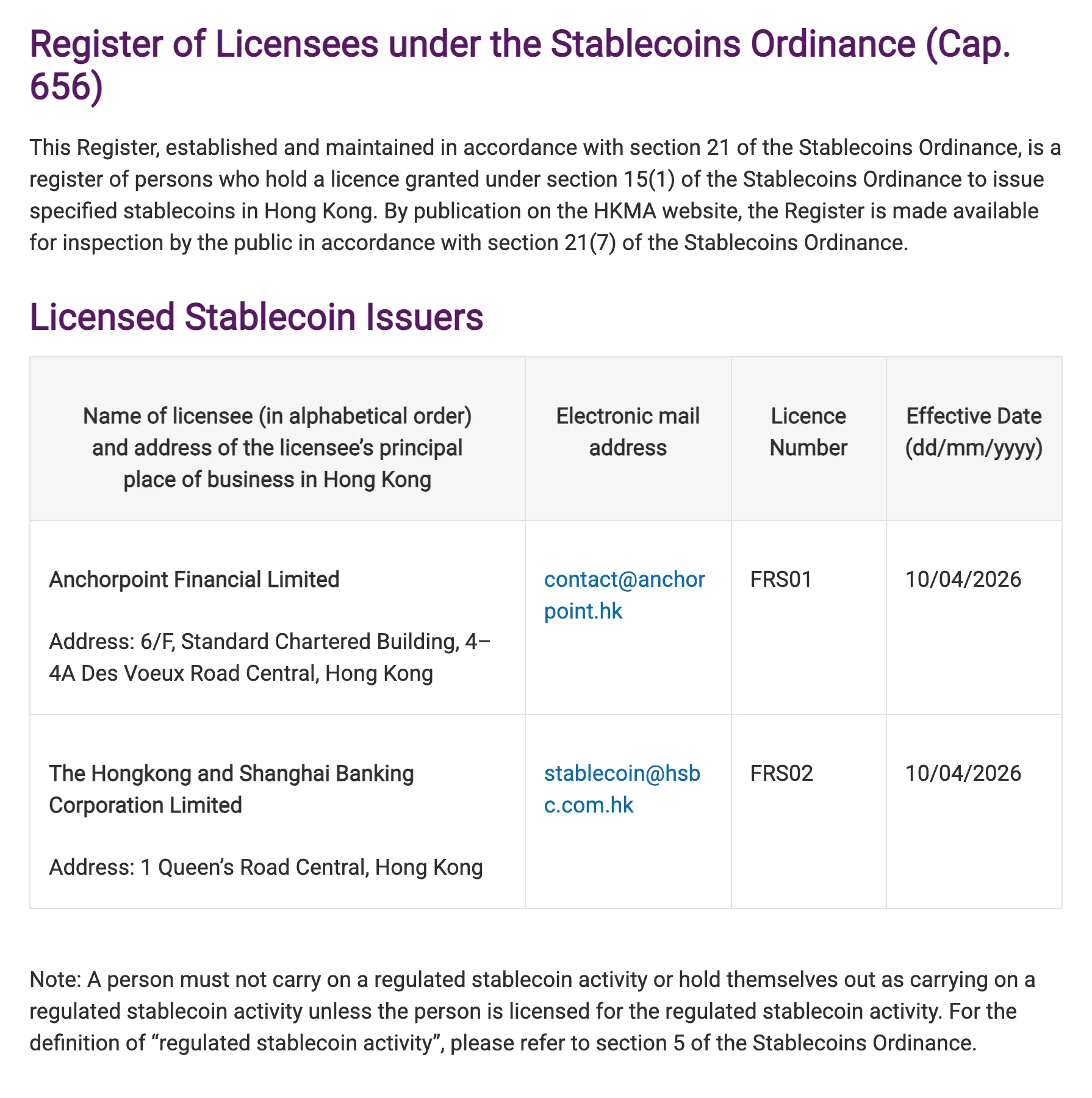
Hong Kong's regime does not change mainland law, and the 2026 notice separately bars unapproved offshore yuan-pegged stablecoins.
Frequently asked questions
Is it illegal to own USDT in China?
The notices do not contain a provision that makes simply holding crypto an offence. They ban crypto business, including exchanging yuan for USDT, tell banks and payment firms not to serve it, and say investment contracts that violate public order and good morals are void. Owning USDT therefore carries no legal protection and practical risks, even where it is not itself an offence.
Did China lift its crypto ban in 2026?
No. The February 2026 notice repealed the 2021 notice and replaced it with a broader one. It keeps the ban on crypto business and adds rules on yuan-pegged stablecoins and real-world asset tokens.
Is P2P trading on an offshore exchange allowed for people in China?
No. The 2026 notice says offshore entities may not provide virtual currency services to parties in China in any form, and the P2P exchange of yuan for USDT inside China is itself a banned activity.
Can a Chinese supplier legally accept USDT for goods?
The notices do not address that situation in a single sentence, but converting the USDT into yuan, which a supplier almost always needs to do, is a banned activity, and the 2023 typical case shows that a foreign-currency-to-USDT-to-yuan chain can be prosecuted as illegal foreign exchange trading. A bank wire to the supplier's company account avoids these problems.
Does the ban apply in Hong Kong?
No. Hong Kong has its own legal system and licenses stablecoin issuers under the Stablecoins Ordinance. Mainland residents remain subject to mainland rules.
Sources
- PBoC et al., Yinfa [2021] No. 237, signed 15 September 2021, published 24 September 2021: pbc.gov.cn
- PBoC et al., Yinfa [2026] No. 42, 6 February 2026: pbc.gov.cn
- SPP and SAFE, typical cases on foreign exchange crimes, 11 December 2023 (PDF): safe.gov.cn
- Supreme People's Court, typical cases on punishing aiding-information-network crimes and related crimes, 28 July 2025: court.gov.cn
- SPC, SPP and MPS officials answer questions on the 2025 opinion, 28 July 2025: court.gov.cn
- Hong Kong Government, commencement date of the Stablecoins Ordinance, 6 June 2025: info.gov.hk
- HKMA, Regulatory Regime for Stablecoin Issuers: hkma.gov.hk
- HKMA, Granting of stablecoin issuer licences, 10 April 2026: hkma.gov.hk
- HKMA, Register of licensees under the Stablecoins Ordinance: hkma.gov.hk