In this article · 9 sections
- What does "frozen card" mean in China's USDT market?
- Police freeze or bank restriction: how can you tell the difference?
- How long does a frozen bank card stay frozen in China?
- Why does a USDT seller's account get frozen?
- What is the "card-breaking" campaign?
- When does a frozen card become a crime?
- What does a frozen supplier account mean for a foreign buyer?
- Frequently asked questions
- Sources
In China's over-the-counter USDT market, a "frozen card" (冻卡, dongka) means a bank or payment account that has been frozen by police or prosecutors in a criminal investigation, or restricted by the bank itself because its fraud monitoring flagged it. The usual trigger is the same in both cases: yuan that came from a fraud victim landed in the account, often because the account holder sold USDT to someone paying with scam money. A police freeze on deposits normally lasts six months and can be renewed. For a buyer outside China, a supplier or dealer whose card is frozen can mean a stalled payment, a refund that never comes, and questions about where your money went.
This is not legal advice.
What does "frozen card" mean in China's USDT market?
In China, people often say "card" (卡) for a bank account, because every personal account comes with a debit card number. 冻卡 is traders' shorthand for anything that stops an account from working normally. It covers two quite different situations, which have different legal bases and end in different ways:
- a judicial freeze (司法冻结, sifa dongjie), ordered by the police, prosecutors or a court as part of a case; and
- a risk-control restriction (风控, fengkong, "risk control"), imposed by a bank or by a payment company such as Alipay (支付宝, Alibaba affiliate Ant Group's payment app) or WeChat Pay (微信支付, Tencent's payment service) on its own initiative.
The people most exposed are the dealers who sell USDT for yuan on peer-to-peer (P2P) boards, known as U merchants (U商, U shang), and the people who rent out or sell their accounts to others.
Police freeze or bank restriction: how can you tell the difference?
Judicial or police freezes (司法冻结)
China's Criminal Procedure Law lets prosecutors and public security organs (公安机关, the police) inquire into and freeze a suspect's deposits, remittances, bonds, stocks and fund shares "according to the needs of investigating crimes", and requires banks and others to cooperate (Article 144 of the law as amended on 26 October 2018). Property that is already frozen may not be frozen again. Article 145 says that frozen property found to be unrelated to the case must be released within three days.
The Ministry of Public Security's procedural rules for criminal cases fill in the details. A freeze needs the approval of the head of a county-level or higher police authority, and the notice sent to the bank must state the account name and number, the amount frozen, the period and the scope (Article 239). An account that is already frozen cannot be frozen twice, but another authority can join a queue to freeze it once the first freeze ends (轮候冻结, Article 242).
In practice, police in the city where a fraud victim reported the crime trace the victim's money hop by hop, and every account it passed through can be frozen, including the account of a U merchant who had no idea the buyer was a fraudster. That is why a seller in Shenzhen can have a card frozen by a police bureau in a province they have never visited, and may be asked to travel there to explain the trade. Traders call this an out-of-town freeze (异地冻结, yidi dongjie).
A draft revision of the Criminal Procedure Law went to the National People's Congress Standing Committee for its first reading on 2 November 2026. Xinhua reports that it includes improving the procedures for sealing, seizing, freezing and disposing of case-related property. It has not been adopted, so article numbers and details may change.
Bank and payment-app restrictions (风控)
The second kind needs no criminal case. The Anti-Telecom and Online Fraud Law (反电信网络诈骗法), adopted by the NPC Standing Committee on 2 September 2022 and in force since 1 December 2022, requires banks and non-bank payment companies to monitor accounts for patterns typical of fraud (Article 18). For accounts and transactions flagged as abnormal they must take "necessary preventive measures" based on the risk: verifying the transactions, re-verifying identity, delaying settlement, or limiting or suspending services.
Traders describe these restrictions in their own shorthand: 只收不付 (zhi shou bu fu, "can receive, cannot pay out"), 不收不付 (bu shou bu fu, "can neither receive nor pay"), or a stop on non-counter services (非柜面业务), meaning no app, online or ATM transfers, so the holder has to go to a branch in person. Under Article 32, an institution that restricts an account for suspected fraud must say why, explain how to seek a remedy and what documents to provide, and the account holder may file a complaint (申诉, shensu) with whoever imposed the measure. If the complaint is upheld, the measure must be lifted at once.
| Judicial or police freeze | Bank or payment-app restriction | |
|---|---|---|
| Who imposes it | Police or prosecutors, often in another province | The bank or payment company itself |
| Legal basis | Criminal Procedure Law, Art. 144; police rules, Art. 239 to 247 | Anti-Telecom and Online Fraud Law, Art. 18 |
| Typical trigger | A victim's money traced into the account | Monitoring flags unusual flows |
| What is blocked | A stated amount in the account | Some or all services, as the bank decides |
| How it ends | Expiry without renewal, release, or handling in the case | Verification, or a complaint under Art. 32 |
How long does a frozen bank card stay frozen in China?
For a police freeze, the rules give a clear default. A freeze on deposits and remittances lasts six months, and each renewal may last at most another six months. In major or complex cases, with approval from police at city level or above, the period can be one year, renewable a year at a time (Article 243). The police must renew before the period ends; if they do not, the freeze is treated as automatically lifted (Article 240). Money found to be unrelated to the case must be released within three days (Article 247).
A worked example: a freeze placed on 15 March runs to 14 September. If the case is still open, the police can renew it before that date for up to another six months, to March of the following year, and again after that. If nobody renews it, the freeze ends with the period. Questions about the case itself have to go to the authority that ordered the freeze, not to the bank.
For a bank or payment-app restriction there is no fixed period in the law. It lasts until the institution is satisfied, which may take one visit to a branch with ID and an explanation of the transactions, or may not happen at all if the bank decides to close the account.
Why does a USDT seller's account get frozen?
Here is a simple, hypothetical chain. A scammer persuades a victim to transfer CNY 50,000. Instead of receiving the money himself, the scammer opens a P2P order to buy about 7,500 USDT from a dealer at CNY 6.64 and gives the dealer's bank card number to the victim as the "payee". The victim pays the dealer. The dealer sees CNY 50,000 arrive, releases the USDT to the scammer, and the scammer is gone. When the victim goes to the police, the dealer's account is the first one the money reached.
From the investigator's point of view, the dealer's card is where the victim's money stopped. The dealer can argue they sold USDT in good faith at a market price, but the freeze comes first and the explanation later. If the police freeze CNY 50,000 in an account holding CNY 200,000, the rest may remain usable, because the freeze notice states an amount; but a bank that sees the same card used for many such trades may also restrict the whole account under its own risk controls. Dealers who keep several cards can have one bad trade affect money from unrelated trades.
This is why P2P ads so often say "no third-party payments" and "names must match": a payment from someone other than the person who opened the order is the classic sign of a scam victim's money. Our guide to P2P ad terms explains these conditions.
What is the "card-breaking" campaign?
On 10 October 2020, the State Council's inter-ministerial joint meeting on fighting new types of telecom and online crime launched a nationwide "card-breaking" campaign (断卡行动, duanka xingdong), according to Xinhua. Its target was the "two cards" (两卡, liang ka): phone cards and bank cards opened, sold or rented out to criminals. People and organisations identified by the police as renting, selling, lending or buying bank or payment accounts were to have the non-counter services of their bank accounts and all services of their payment accounts suspended for five years, and banks were not to open new accounts for them. The same report said that in 2020 to that date the police had stopped or frozen more than CNY 100 billion of funds linked to fraud.
The campaign has continued. At a press conference on 28 July 2025, the Ministry of Public Security said that so far that year its criminal investigation bureau had issued 780,000 card-breaking leads, dealt with 230,000 suspects, broken up more than 5,500 gangs opening cards illegally, seized more than 170,000 illegal cards and caught 23 insiders at banks and telecom operators.
The 2022 anti-fraud law wrote the core of the campaign into statute. Article 31 bans illegally buying, selling, renting or lending phone cards, bank accounts, payment accounts and internet accounts, and bans helping others pass real-name checks. People found by city-level or higher police to have done so can have it recorded in their credit records and face limits on their cards and accounts, including stops on non-counter services. Article 44 sets confiscation of illegal gains and fines of one to ten times those gains (up to CNY 200,000 where there are no gains or gains under CNY 20,000), and up to 15 days' detention in serious cases.
When does a frozen card become a crime?
The criminal offence most often linked to frozen cards is Article 287-2 of the Criminal Law, added by Criminal Law Amendment IX with effect from 1 November 2015. It punishes knowingly helping others who use information networks to commit crimes, including by providing payment settlement, where the circumstances are serious, with up to three years' imprisonment or criminal detention, plus or only a fine. Chinese media shorten its name to 帮信罪 (bangxin zui).
A 2019 judicial interpretation by the Supreme People's Court and Supreme People's Procuratorate (Fa Shi [2019] No. 15, issued 21 October 2019, effective 1 November 2019) fills in the details:
- Knowledge can be inferred from circumstances that include "clearly abnormal" transaction prices or methods, or frequent use of hidden internet access, encrypted communication, data destruction or false identities to evade supervision (Article 11), unless there is evidence to the contrary.
- "Serious circumstances" include helping three or more parties, payment settlement of CNY 200,000 or more, or illegal gains of CNY 10,000 or more (Article 12).
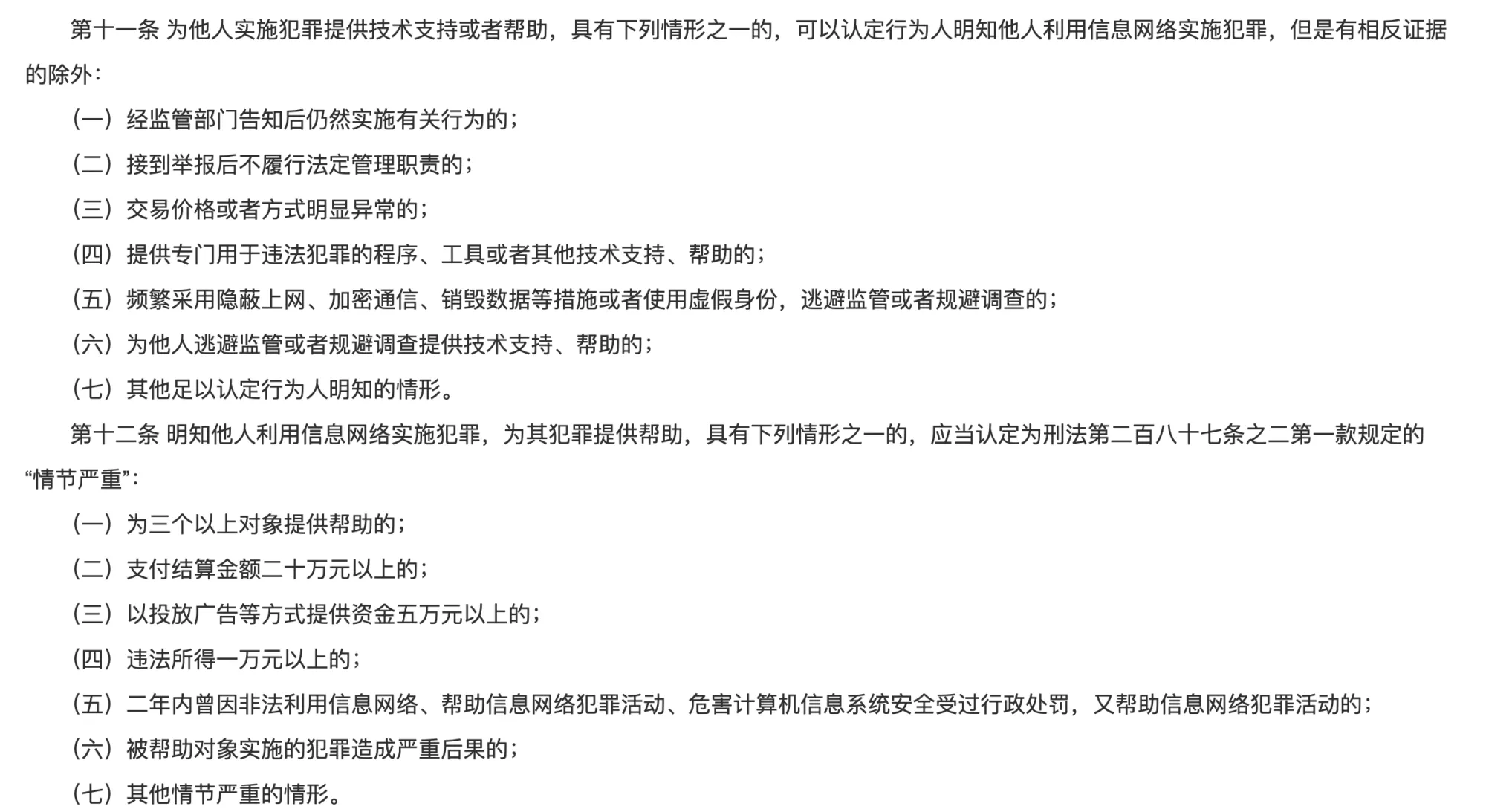
For a P2P dealer, this matters because a pattern of high-volume trades through many cards, at prices well away from the market, can look like the "abnormal" behaviour the interpretation describes, and CNY 200,000 is a small sum for a busy dealer.
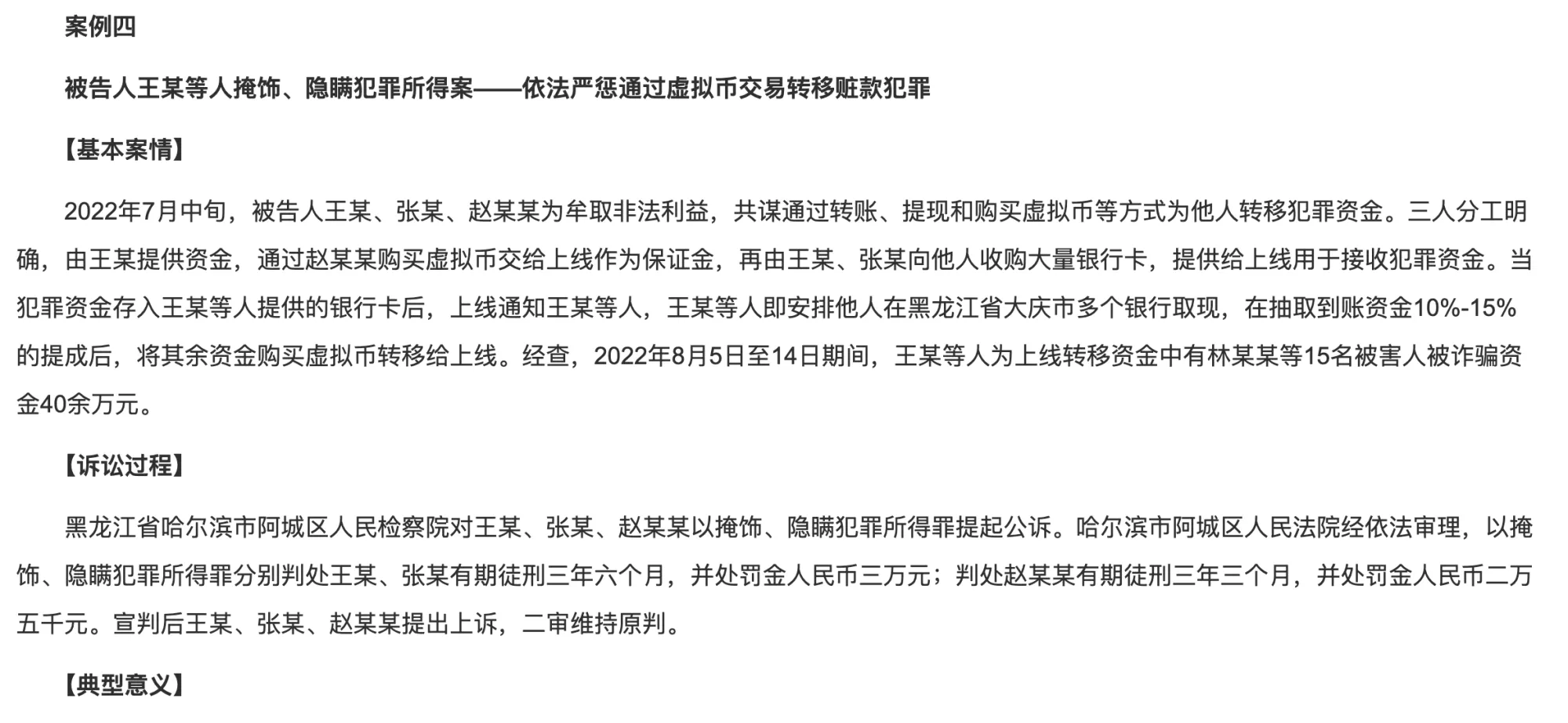
On 28 July 2025, the Supreme People's Court, the Supreme People's Procuratorate and the Ministry of Public Security issued a further opinion on these cases, together with seven typical cases. Two involved moving fraud proceeds by buying virtual currency. In one, three people bought bank cards, had fraud victims' money paid into them, withdrew it in cash, kept 10% to 15% and bought virtual currency with the rest; they were convicted of concealing criminal proceeds (掩饰、隐瞒犯罪所得罪) and sentenced to between three years three months and three and a half years. In the other, a man who moved more than CNY 6.51 million through bank, Alipay and WeChat accounts and crypto purchases for a 1.5% to 3% cut was convicted of fraud as an accomplice. Officials said that people who had a prior agreement or a stable working relationship with fraudsters should be treated as accomplices to fraud, a heavier charge.
Behind all of this sits the broader rule: in mainland China, exchanging yuan for crypto as a business is illegal financial activity. The current notice from the People's Bank of China and seven other agencies (Yinfa [2026] No. 42, 6 February 2026), which repealed the 2021 notice, says fiat-crypto exchange business inside China is strictly prohibited and tells banks and payment companies not to provide accounts, transfers or clearing for it. See our guide on whether crypto is legal in China.
What does a frozen supplier account mean for a foreign buyer?
If you pay a Chinese supplier in USDT and the supplier, or the dealer who converts that USDT into yuan for them, has a card frozen, a few things follow:
- The money can stall on the Chinese side. Your USDT may have arrived, but the supplier says the yuan is stuck. You cannot verify this, and there is no bank to ask.
- Your payment may be part of a tainted chain. If the dealer's yuan came from fraud victims, the USDT you sent may be traced as part of the same flow. On-chain, USDT itself can also be frozen at an address by its issuer. See the glossary entry for 黑U, "black U".
- Chinese courts may not protect the deal. Because the conversion is illegal financial activity in mainland China, a court may treat the related arrangement as void, which weakens any claim you have there.
- New payment instructions are a warning sign. A supplier who suddenly asks you to pay a different person, a personal card or a new wallet "because our account is frozen" is a classic setup for fraud or for routing tainted money through you.
None of this can be fully avoided by the buyer. A documented bank wire to the supplier's company account reduces exposure to these problems, at the cost of fees and time. Compare the routes in USDT vs bank wire vs payment agents, read our pages on buyer risks and red flags, and check the current P2P sell price if a supplier quotes you a conversion rate.
Frequently asked questions
How long does a police freeze on a Chinese bank account last?
For deposits and remittances, six months by default, renewable for up to six months at a time; in major or complex cases, one year, renewable a year at a time. If the police do not renew before the end of the period, the freeze is treated as lifted.
How do I know whether an account was frozen by police or restricted by the bank?
Ask the bank. A judicial freeze is ordered by a police, prosecution or court authority and covers a stated amount for a stated period (Article 239 of the police rules). A risk-control restriction is the bank's own decision, often described as receive-only, fully blocked, or a stop on non-counter services, and under Article 32 of the anti-fraud law the bank must tell you the reason and how to complain.
Can a frozen account be unfrozen by complaining to the bank?
A bank's own restriction can be challenged with a complaint under Article 32 of the anti-fraud law, and must be lifted at once if the complaint is upheld. A police freeze is not the bank's decision; only the authority that ordered it, or the end of its period, can lift it.
Why would selling USDT at a fair price lead to a freeze?
Because the freeze follows the money, not the price. If the buyer paid with a fraud victim's money, the seller's account is where the trail stops, whatever the seller knew.
Does a frozen card mean the account holder committed a crime?
No. A freeze is an investigative step. A crime such as assisting network crime requires knowledge, which can be inferred from circumstances such as clearly abnormal prices or methods, and serious circumstances such as CNY 200,000 in payment settlement.
Sources
- Criminal Procedure Law of the PRC, as amended 26 October 2018, Articles 144 and 145 (State Taxation Administration law database copy): chinatax.gov.cn
- Ministry of Public Security, Procedural Provisions for Public Security Organs Handling Criminal Cases (2012, amended 2020), Articles 239 to 247 (copy on the National Immigration Administration website, PDF): nia.gov.cn
- Xinhua, Criminal Procedure Law revision draft submitted for first reading, 2 November 2026: news.cn
- Anti-Telecom and Online Fraud Law of the PRC, adopted 2 September 2022, effective 1 December 2022, full text from the NPC website as reprinted by The Paper: thepaper.cn
- Xinhua via People's Political Consultative Daily, nationwide "card-breaking" campaign deployed, 10 October 2020: rmzxw.com.cn
- Supreme People's Court, press conference on Fa Shi [2019] No. 15, with the text of Criminal Law Art. 287-2, 25 October 2019: court.gov.cn
- SPC and SPP, Interpretation on crimes of illegally using information networks and assisting information network criminal activities, Fa Shi [2019] No. 15: court.gov.cn
- SPC, SPP and MPS officials answer questions on the 2025 opinion, 28 July 2025: court.gov.cn
- SPC, typical cases on punishing aiding-information-network crimes and related crimes, 28 July 2025: court.gov.cn
- PBoC and seven agencies, Yinfa [2026] No. 42, 6 February 2026: pbc.gov.cn