In this article · 14 sections
- Where does the USDT/CNY price come from?
- Buy price or sell price: which one applies to me?
- Why does the order size change the USDT price?
- Which P2P ads count towards the price?
- How does coinkiki turn the ads into one price?
- Why use the middle of five ads instead of the cheapest?
- How often is the USDT/CNY rate updated?
- Are prices shown separately by payment method?
- Which dollar rate is the premium measured against?
- Daily history and downloads
- What are the limits of this rate?
- How to cite coinkiki's USDT/CNY data
- Frequently asked questions
- Sources
coinkiki's USDT/CNY rate is the price at which dealers are currently offering to buy or sell USDT for Chinese yuan in the public peer-to-peer (P2P) ads on Binance, OKX and HTX. For each exchange we look only at ads that could take a given order size from a dealer with a completion rate of at least 95% and at least 50 orders, and we report the middle price of the five best of them. It is updated every 3 minutes. It is an advertised price, not an executed trade and not an official exchange rate.
| Order of | Highest sell | Lowest buy |
|---|---|---|
| CNY 5,000Small | 6.630HTX | 6.630Binance |
| CNY 50,000Medium | 6.630Binance | 6.630Binance |
| CNY 300,000Large | 6.640Binance | 6.630Binance |
Live data, CNY per USDT · updated 20:18 Beijing time · premium −0.85% · full board
The rest of this page explains each step in plain terms, with real examples from the exchanges' own pages, so you can decide how far to rely on the number and how to quote it.
Where does the USDT/CNY price come from?
USDT, also called Tether, is a stablecoin: a crypto token designed to be worth one US dollar. Inside mainland China there is no bank or licensed exchange where you can swap yuan for USDT. What exists instead is an informal over-the-counter (OTC) market, and much of it runs through the P2P sections of large crypto exchanges, also called C2C boards.
On a P2P board, individuals and dealers post standing offers. A dealer who sells USDT says, in effect, "I will sell up to 20,000 USDT at CNY 6.64 each, in orders between CNY 50,000 and CNY 200,000, paid to my Alipay." Chinese traders call these dealers U merchants (U商, U shang, from "U", slang for USDT). The buyer does not pay the exchange. The buyer pays the dealer directly through a Chinese payment channel: a bank transfer, Alipay (支付宝, the payment app of Alibaba's affiliate Ant Group) or WeChat Pay (微信支付, the payment function inside Tencent's WeChat messaging app). The exchange holds the dealer's USDT in escrow and releases it once the dealer confirms the yuan has arrived.
The ads are public. Anyone can open the CNY page of each exchange's P2P board in a browser, without logging in, and see the same list coinkiki reads: price, the amount of USDT on offer, the minimum and maximum order, the accepted payment methods, and the dealer's track record. coinkiki covers three exchanges and shows each one separately on the rate page and the exchange pages for Binance, OKX and HTX. We do not rank them and we do not recommend any of them.
Buy price or sell price: which one applies to me?
Every price on coinkiki is stated from the point of view of the person using the board, not the dealer:
| Price | Meaning | Better for you when it is | Who usually needs it |
|---|---|---|---|
| Buy price | Yuan you pay for 1 USDT | Lower | Someone in China turning yuan into USDT |
| Sell price | Yuan you receive for 1 USDT | Higher | A supplier in China who was paid in USDT and needs yuan |
The buy price is normally a little above the sell price, and the gap between them is the dealers' margin. A dealer who sells at 6.64 and buys back at 6.61 earns 0.03 yuan per USDT, about 0.45%, before the cost of the risks described later on this page.
For an importer who pays a Chinese supplier in USDT, the sell price is the relevant one: it is roughly what the supplier gets in yuan for each USDT you send. Our guide to what rate a supplier can expect walks through that case, and the converter does the arithmetic for a given amount.
Why does the order size change the USDT price?
On a P2P board, the cheapest ad at the top of the list is often one you cannot use. Each ad has a minimum and a maximum order in yuan, and many of the keenest prices come with a high minimum, a very low maximum, or only a little USDT left. What you can actually get depends on how much you want to trade.
So coinkiki calculates every price at three fixed order sizes:
| Order size | In US dollars (at 6.7167) | Typical use |
|---|---|---|
| CNY 5,000 (small) | about USD 745 | A small personal trade |
| CNY 50,000 (medium) | about USD 7,440 | A mid-sized transfer; used for the premium |
| CNY 300,000 (large) | about USD 44,700 | A large dealer-sized trade |
The dollar figures use the official central parity rate of 6.7167 yuan per dollar published on 10 November 2026, and are only there to give a sense of scale.
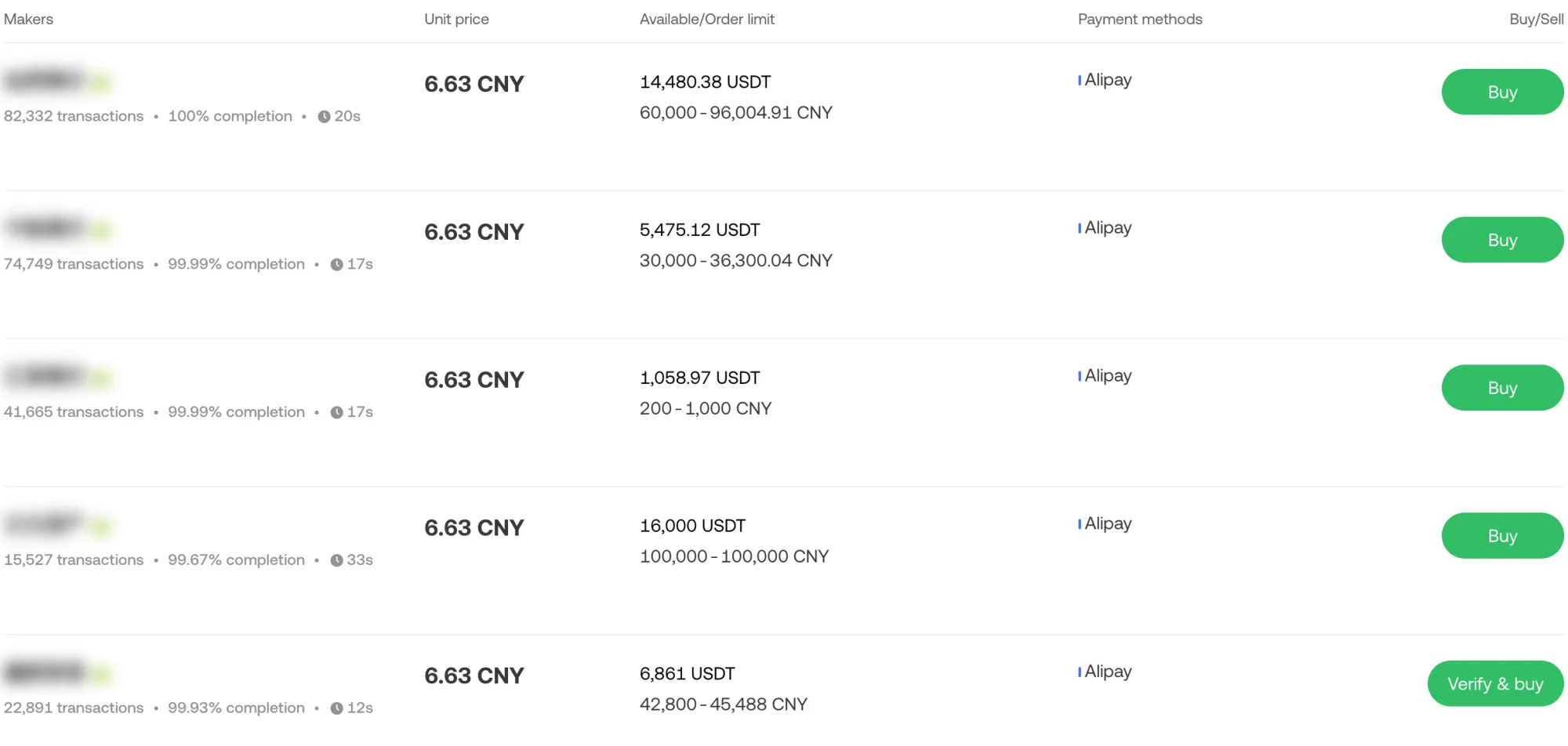
The OKX screenshot below shows why this matters. At that moment the first five ads in the list were all at CNY 6.63, the lowest price on offer, but none of them could take a single order of CNY 50,000: one ran from CNY 200 to 1,000, one from 30,000 to 36,300.04, one from 42,800 to 45,488, one from 60,000 to 96,004.91, and one accepted exactly CNY 100,000. A buyer with CNY 50,000 to spend would have had to look further down the list, and possibly pay more.
Which P2P ads count towards the price?
For each exchange, each side (buy or sell) and each order size, an ad counts only if it meets all four of these conditions:
- It can take the whole amount in one order. The ad's minimum must be at or below the order size and its maximum at or above it. A CNY 50,000 order cannot use an ad limited to CNY 60,000 to 96,004.91, however good its price.
- It has enough USDT left. At the ad's price, the USDT still on offer must cover the full amount. At CNY 6.64, a CNY 50,000 order needs about 7,530 USDT, so an ad with 5,000 USDT left does not count for that size.
- The dealer finishes trades. The dealer's completion rate, the share of accepted orders that ended in a finished trade rather than a cancellation, must be at least 95%.
- The dealer has a track record. The dealer must have at least 50 completed orders. Binance and HTX show a count for the last 30 days. OKX shows only a lifetime count, so for OKX that is what we use, which is a looser test.
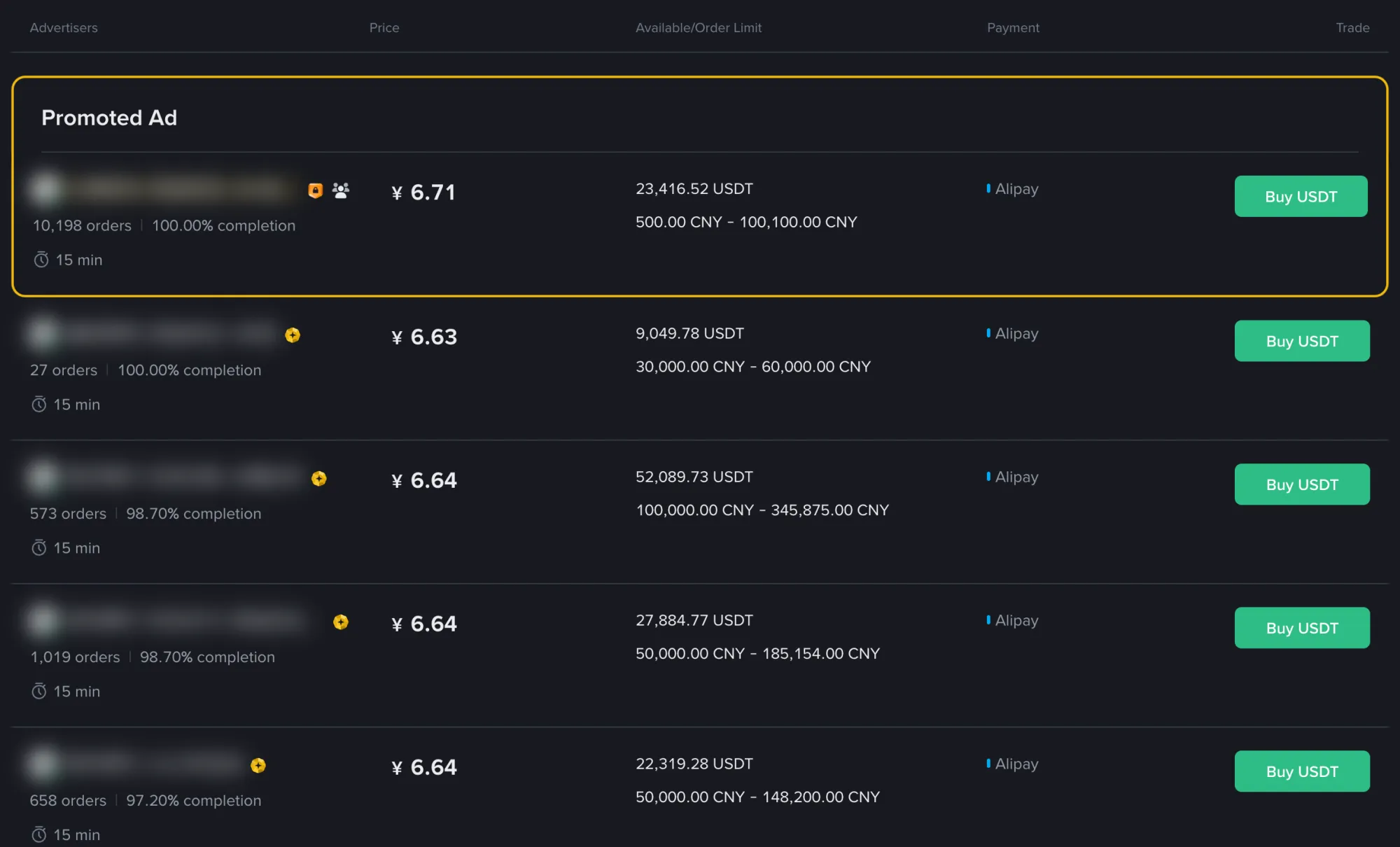
In the Binance screenshot above, the ad at CNY 6.63 came from a dealer with 27 orders, so it would not count, and its CNY 30,000 to 60,000 limit would rule it out of the small and large sizes anyway. The promoted ad at 6.71 passes on track record but sits well above the ordinary ads, which shows why the top of a list is not the market.
How does coinkiki turn the ads into one price?
Once it is clear which ads meet all four conditions, three steps follow:
- Sort them from best to worst for you: lowest price first when you are buying, highest first when you are selling.
- Take the best five.
- Report the middle one of those five, which is the third best. If only four or two ads meet the conditions, the price is halfway between the two in the middle.
Here is a worked example with made-up numbers for buying at the medium size (CNY 50,000) on one exchange. Assume every ad has enough USDT left to fill the order:
| Ad | Price (CNY) | Limits (CNY) | Completion | Orders | Counts? |
|---|---|---|---|---|---|
| A | 6.61 | 100,000 to 500,000 | 99% | 800 | No: minimum too high |
| B | 6.62 | 10,000 to 80,000 | 97% | 30 | No: under 50 orders |
| C | 6.63 | 20,000 to 150,000 | 99% | 1,200 | Yes |
| D | 6.63 | 5,000 to 60,000 | 96% | 310 | Yes |
| E | 6.64 | 50,000 to 300,000 | 98% | 950 | Yes |
| F | 6.64 | 1,000 to 50,000 | 100% | 75 | Yes |
| G | 6.65 | 30,000 to 200,000 | 92% | 2,000 | No: completion under 95% |
| H | 6.66 | 10,000 to 100,000 | 99% | 640 | Yes |
| I | 6.70 | 10,000 to 100,000 | 99% | 400 | Yes, but not among the best five |
The five best ads that meet the conditions are C, D, E, F and H, at 6.63, 6.63, 6.64, 6.64 and 6.66. The middle one is 6.64, so the medium-size buy price for this exchange would be CNY 6.64. Ads A and B look cheaper but a buyer of CNY 50,000 could not use A, and B has too short a record.
Two special cases:
- Fewer than five ads meet the conditions. We use the middle price of those that do and mark the price "few ads": there are few ads to go by, so treat the price as a rough reference. With three such ads at 6.63, 6.64 and 6.70, the price would be 6.64.
- No ad meets the conditions. That exchange shows no price for that size and side. We do not borrow a price from another order size or carry an old price forward.
Why use the middle of five ads instead of the cheapest?
The single cheapest ad is a poor guide. It may be a promoted ad, a "bait" ad priced to attract clicks from a dealer who then stalls or adds conditions, or simply a dealer who will sell 500 USDT at that price and no more. Averaging every ad on the board would be no better, because it would drag in prices that no careful buyer would accept.
The middle of the best five sits between those extremes. It is close to what a buyer could realistically get by choosing among the better ads, and one odd ad moves it very little. In the worked example, if ad C were repriced to 6.50 to grab attention, the middle of the five would still be 6.64.
How often is the USDT/CNY rate updated?
Prices are refreshed every 3 minutes, around the clock, including weekends and Chinese public holidays, because the P2P market never closes. Next to each price the site shows the change from 24 hours earlier.
Each exchange is read separately. If one of them stops updating, for example because it changed its web pages, the other two carry on, and the exchange that has had no new data for 20 minutes or more is shown faded with a note, so an out-of-date price is never presented as current.
Are prices shown separately by payment method?
No. Prices often differ depending on how the buyer pays, but the prices on this site are worked out from all qualifying ads, whichever payment methods they accept. What each exchange page does show is the mix of methods: for the medium size (CNY 50,000), how many ads that can take the order accept bank transfer, Alipay and WeChat Pay on the sell side and on the buy side, and each method's share of the buy-side ads. One ad can accept several methods, so the counts add up to more than the number of ads. What these methods are and why their prices can differ is covered in our guide to Alipay, WeChat and bank card ads.
Which dollar rate is the premium measured against?
To compare the P2P price with the ordinary currency market, coinkiki shows two reference rates for the dollar:
- USD/CNY, the onshore yuan traded inside mainland China, and
- USD/CNH, the offshore yuan traded outside the mainland, mainly in Hong Kong.
Both come from ExchangeRate-API's free open-access service, whose documentation says the data "only refreshes once every 24 hours". This is a market reference rate, not the official central parity rate (中间价, zhongjianjia), which the China Foreign Exchange Trade System (CFETS) publishes each business day on behalf of the People's Bank of China. Its 10 November 2026 USD/CNY central parity was 6.7167. If you need the official figure, take it from CFETS's central parity page. The difference between the two is explained in why USDT trades at a discount or premium.
The premium is then:
Premium = (lowest medium-size buy price among the three exchanges − USD/CNY) ÷ USD/CNY
A worked example with illustrative numbers: if the lowest medium-size buy price is 6.64 and the USD/CNY reference is 6.72, the premium is (6.64 − 6.72) ÷ 6.72, about −1.19%. A negative figure is a discount: USDT is cheaper in yuan than the dollar. If the buy price were 6.85 against the same reference, the premium would be about +1.93%. The site shows the same calculation for the sell side. Because the reference changes once a day while ads change every few minutes, intraday moves in the premium come almost entirely from the P2P side. The live figure and its history are on the China USDT premium page.
Daily history and downloads
For each Beijing-time calendar day (UTC+8), coinkiki keeps the day's average, low, high and last price for every exchange, side and order size, and a daily premium. The numbers for a day stop changing after midnight Beijing time and are kept permanently. They can be downloaded as CSV files from the data page. If an exchange was not updating for part of a day, its figures for that day are based on fewer readings; days with no prices at all are left empty rather than filled in.
What are the limits of this rate?
- An ad price is not a trade price. We see what dealers offer. A real trade can be done at another price, or not at all.
- Prices move between updates. An ad can change or disappear in the minutes between two updates, or between our update and your click.
- Exchanges control their pages. If an exchange redesigns its P2P pages, its prices may stop updating for a while, which the site marks.
- Track records are not the same everywhere. OKX's lifetime order count is a weaker test than the 30-day count on Binance and HTX.
- Bait ads and tainted money exist. The four conditions and the middle-of-five rule reduce the effect of misleading ads, but no price can tell you whether a dealer's money is clean or whether an account will be frozen later. See frozen bank cards in China's OTC market.
- The reference rate is not official. It is a daily market rate, not the CFETS central parity.
- Nothing here is advice. coinkiki does not rank or recommend exchanges or dealers. In mainland China, exchanging yuan for crypto as a business is illegal financial activity; see whether crypto is legal in China and our risk notes.
How to cite coinkiki's USDT/CNY data
The data is published under the Creative Commons Attribution 4.0 licence (CC BY 4.0). Please credit it as:
Source: coinkiki (coinkiki USDT/CNY OTC reference rate)
with a link to coinkiki or the data page. When you quote a figure, give the date and time in Beijing time, the order size, the side (buy or sell) and the exchange, and say that it is a reference rate built from advertised P2P prices rather than a traded price. A sentence in this form works: "At [time] Beijing time on [date], the medium-size (CNY 50,000) USDT buy price on Binance's P2P board was CNY [price], according to coinkiki's ad-based reference rate."
Frequently asked questions
Is the coinkiki rate the price I will actually get?
Not necessarily. It is the middle of the five best ads that could take your order size at the time of the last update. A real trade depends on which ad you pick, whether it is still there, and what the dealer agrees to. Treat it as a guide to the going rate, not a quote.
Why does coinkiki show three different prices for the same exchange?
Because the price depends on how much you trade. Many ads accept only a narrow range of order sizes, so the ads available for CNY 5,000 are not the same as those for CNY 300,000. Each size gets its own price.
Why is there no price for one exchange?
Either no ad met the four conditions for that size and side, or that exchange has not updated for a while, in which case the price is shown faded with a note. We never fill the gap with a price from another size or an older reading.
Why is the USDT/CNY rate different from the official dollar rate?
USDT trades in an informal market shaped by China's capital controls and by the legal and banking risks of each trade, so its yuan price can sit above or below the dollar's. Our guide on why USDT trades at a discount or premium explains the causes.
Does coinkiki pick or adjust the prices by hand?
No. The numbers are calculated from the live ads under the fixed rules on this page. Nobody chooses which ads to include, and no price is edited after the fact.
Can I use coinkiki's numbers in an article or report?
Yes, under CC BY 4.0, with credit as described above. Say that the figure is an ad-based reference rate, and give the time, order size, side and exchange.
Sources
- Binance P2P, CNY ads for USDT (public page): p2p.binance.com
- OKX P2P, CNY ads for USDT (public page): okx.com
- ExchangeRate-API, free open-access service documentation: exchangerate-api.com
- CFETS, CNY central parity rate: chinamoney.com.cn
- Creative Commons, Attribution 4.0 International: creativecommons.org