In this article · 12 sections
- What is USDT in plain terms?
- How much USDT exists, and on which networks?
- What backs USDT? Tether's reserves explained
- Has Tether been in trouble over its reserves before?
- Can USDT lose its dollar peg?
- Can Tether freeze my USDT?
- Is it safe to hold USDT? The risks side by side
- Wallet or exchange: who actually holds your USDT?
- Is it safe to pay a supplier with USDT?
- A short checklist before you hold or pay with USDT
- Frequently asked questions
- Sources
USDT (also written USD₮ and often called Tether) is a digital token issued by a private company, Tether, and designed to be worth one US dollar. It lives on public blockchains such as Tron and Ethereum, so it can be sent anywhere in minutes. It is reasonably dependable for moving money over a short period, but it is not a bank deposit: there is no deposit insurance, Tether can freeze any address holding it, its price has briefly fallen below a dollar, and US regulators have found that its reserves were not always fully backed in the past. Whether it is "safe" for you depends less on the token than on who holds it for you, where the coins came from, and whether you send them correctly.
This guide is written for people who have never used crypto: importers asked to pay a Chinese supplier in USDT, exporters whose Chinese clients offer to pay that way, and anyone who needs to understand the risks before saying yes.
What is USDT in plain terms?
Think of USDT as a digital IOU for dollars that anyone can pass around without a bank in the middle.
- Who issues it. Tether's transparency page names the issuer as Tether International, S.A. de C.V. It is a company, not a bank and not a central bank.
- How a USDT is created. A customer verified by Tether sends dollars to Tether, and Tether issues the same number of tokens on a blockchain. When a verified customer hands tokens back, Tether destroys them and pays out dollars. Tether's terms say you "must be a verified customer of Tether" to have tokens issued or redeemed.
- How everyone else gets it. Almost nobody deals with Tether directly. People buy and sell USDT on exchanges or from other people, and pay for it in dollars, euros, yuan or other currencies.
- Where it lives. USDT exists on more than a dozen blockchains. Tether's supported-protocols page says tokens on different chains "should be treated equally and interchangeably", but in practice a token sent on Tron stays on Tron. Which network to choose is covered in USDT on Tron vs Ethereum.
Can I swap USDT for dollars with Tether myself?
Only if you are a large, verified customer. Tether's fees page, viewed on 10 November 2026, lists:
| Item | Tether's published terms |
|---|---|
| Minimum to buy or redeem directly | USD 100,000 |
| Fee to obtain USDT | 0.1% |
| Fee to redeem USDT for dollars | the greater of USD 1,000 or 0.1% |
| Account verification fee | 150 USDT, non-refundable |
At those rates, redeeming USD 100,000 costs USD 1,000 (1%), redeeming USD 500,000 still costs USD 1,000 (0.2%), and redeeming USD 2 million costs USD 2,000 (0.1%). For an importer paying a USD 20,000 invoice, the direct route does not exist. You depend on an exchange or a dealer to turn USDT back into money, and the price you get there can differ from one dollar.
How much USDT exists, and on which networks?
Tether publishes circulation figures, which it says are "typically published daily". On 10 November 2026 the page, last updated 8 November, showed about USD 176.96 billion of USD₮ in net circulation. Two networks hold almost all of it:
| Network | Net circulation | Share |
|---|---|---|
| Tron | USD 92.31 billion | about 52% |
| Ethereum | USD 80.57 billion | about 46% |
| All other networks combined | about USD 4.1 billion | about 2% |
This matters for a newcomer because a counterparty who asks for USDT will almost always mean one of these two networks.
What backs USDT? Tether's reserves explained
Tether says all its tokens "are backed 100% by Tether's Reserves" and that "the Tether Issuer's assets exceed its liabilities". The figures it shows from its most recent reserves report, dated 30 September 2026:

| Item | Amount |
|---|---|
| Total assets | USD 191.45 billion |
| Total liabilities (mostly tokens in circulation) | USD 183.50 billion |
| Net equity (the cushion) | USD 7.95 billion |
The cushion is about 4.3% of liabilities, or about 4.15% of total assets. In other words, if the reserve assets lost more than about 4.15% of their value, they would no longer cover every token at one dollar.
Three points from Tether's own terms of service are worth reading slowly:
- The reserves "are comprised of cash, cash equivalents and other assets" and "may include loan receivables and other assets from Affiliates". Not all of it is cash in a bank.
- Tether tokens "are not legal tender and are not backed by any Government".
- They are not covered by the US Federal Deposit Insurance Corporation. If Tether failed, there is no insurer standing behind holders.
Has Tether been in trouble over its reserves before?
Yes, and anyone deciding whether to hold USDT should know the history.
- New York, February 2021. The New York Attorney General settled with Tether and its sister company Bitfinex for USD 18.5 million. The office found that for periods of time Tether lacked reserves to back every token in circulation at one dollar each, and required Tether to publish regular breakdowns of its reserve assets.
- US Commodity Futures Trading Commission (CFTC), October 2021. The CFTC fined Tether USD 41 million. Its order found that Tether held enough fiat reserves to back USDT "for only 27.6% of the days" in a 26-month sample from 2016 to 2018.
Both cases concern the past, and Tether now publishes quarterly reserve figures. But they show why "backed 1:1" is a claim made by the issuer, which you are trusting, rather than something a regulator checks every day.
Can USDT lose its dollar peg?
It has, briefly. On 12 May 2022, during the collapse of another stablecoin, TerraUSD, USDT fell to as low as 95 cents on some exchanges at around 3:15 a.m. US Eastern time, according to CNBC. By the afternoon it was trading at USD 0.998. Tether's chief technology officer said about 300 million tokens had been redeemed in the previous 24 hours, and the company said it expected to process more than USD 2 billion of redemptions that day.
What that means in numbers: if you held 50,000 USDT and had to sell at the low, you would have received about USD 47,500, a loss of USD 2,500 in a few hours. If you could wait, the price came back. Small day-to-day deviations are normal: on 10 November 2026 Etherscan showed USDT's market price at USD 0.998996.
For someone paying a supplier, the practical lesson is simple: USDT held for hours or days carries little price risk in normal markets, but it is not risk-free cash, and stress events happen without warning.
Can Tether freeze my USDT?
Yes. This is the biggest difference from cash in your pocket, and the one most newcomers do not expect.
Tether's terms of service say it may "freeze any Tether Tokens held by you", and that for prohibited uses it may blacklist "any Digital Tokens Address which holds Tether Tokens" and report to authorities "without providing any notice to you". A frozen address still shows its balance, but the holder cannot move the tokens.
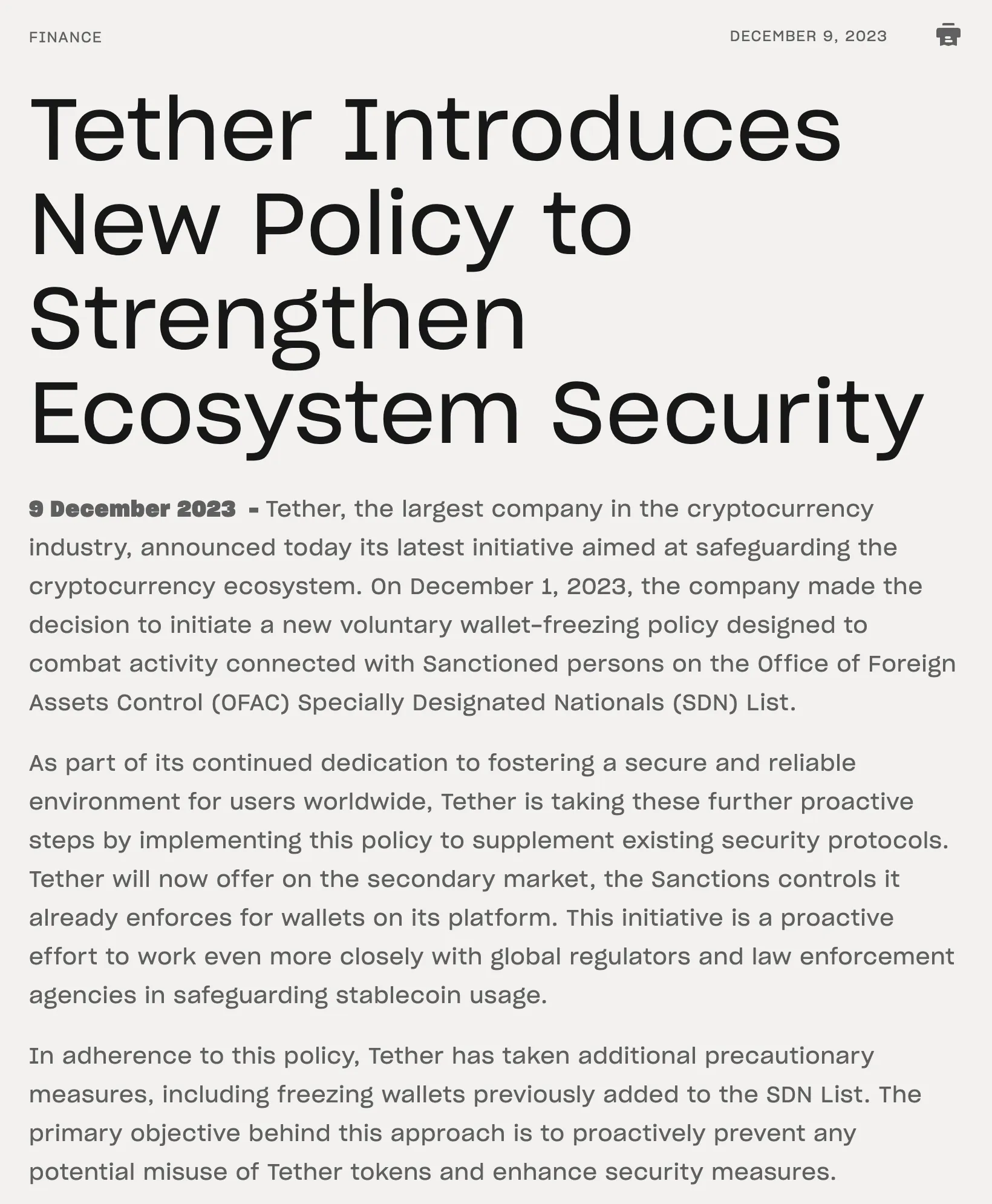
In December 2023 Tether went further and announced a voluntary policy of freezing wallets belonging to people on the US sanctions list (the Office of Foreign Assets Control's Specially Designated Nationals list), including addresses added to that list in the past.
Freezes are frequent and sometimes very large:
| When | What happened | Reported by |
|---|---|---|
| November 2023 | About USD 225 million frozen, linked to a human-trafficking and "pig butchering" investigation in Southeast Asia | The Block |
| Whole of 2025 | About USD 1.26 billion frozen across 4,163 addresses: 3,506 on Tron (about USD 853 million) and 657 on Ethereum (about USD 403 million) | BlockSec |
| January 2026 | About USD 182 million frozen across five Tron wallets | The Block |
| 23 April 2026 | More than USD 344 million frozen in two Tron addresses, coordinated with OFAC and US law enforcement | The Block |
In an announcement on 2 November 2026, Tether said it had frozen more than USD 7 billion of USDT in total, mostly in addresses linked to fraud and theft, and had returned about USD 1.2 billion of it to owners and law enforcement (Tether). Chinese police requests are covered in Tether freezes and Chinese police. Tether said its April 2026 freeze followed information linked to sanctions evasion, criminal networks or other illicit activity, and that is the usual target rather than ordinary businesses. The risk for an ordinary user is indirect: if the USDT you receive came from a scam, and the address holding it is later blacklisted, you can be left holding tokens you cannot move. That is one reason exporters and importers ask who is paying and from where, which is covered in how to receive USDT from a Chinese client or supplier.
Is it safe to hold USDT? The risks side by side
| Risk | What it means | How much control you have |
|---|---|---|
| Issuer and reserve risk | Tether's assets might not cover all tokens | None, beyond limiting how much and how long you hold |
| Price (depeg) risk | Market price can dip below USD 1, as in May 2022 | Some: hold for short periods, avoid forced selling |
| Freeze risk | Tether can blacklist the address holding your tokens | Some: know where incoming coins come from |
| Custody risk | An exchange holding your USDT can restrict your account, or fail | Some: choose who holds it, keep records |
| User error | Wrong address or wrong network; Tether's terms say "Tether Token transactions are not reversible" | High: check every address and send a test first |
| Legal risk | Rules differ by country; in mainland China, crypto-related business is banned | Some: know the rules where you and your counterparty are |
User error is the risk you control most, and it causes many real losses. The steps are in how to check a USDT address and send a test payment first.
Wallet or exchange: who actually holds your USDT?
A newcomer usually has two options:
- An exchange account. The exchange holds the tokens and shows you a balance. It handles the blockchain side and lets you convert to dollars, but it can ask questions about where funds came from and restrict your account while it checks.
- Your own wallet. An app or device that holds the private key, the secret that controls the address. Nobody can restrict an account, because there is no account, but if you lose the key or the recovery phrase, the money is gone. Tether can still freeze the address itself.
Neither is safe or unsafe in itself. What matters is that you know which one you are using and what can go wrong with it.
Is it safe to pay a supplier with USDT?
Paying in USDT moves the money quickly, but it removes protections you have with a bank wire: there is no recall, no chargeback and, if the supplier is in mainland China, no reliable court to help. China's central bank and seven other agencies said in Notice Yinfa [2026] No. 42, dated 6 February 2026, that Tether and other virtual currencies are not legal tender and that virtual-currency business activities in mainland China are illegal financial activities. The legal side is explained in Is buying USDT or crypto legal in China?, and the commercial side in Can I pay a Chinese supplier in USDT? and the risks of paying a Chinese supplier in USDT.
A useful worked example: a USD 30,000 order paid in USDT. If the supplier's address is wrong, the money is lost. If the supplier's yuan bank account is frozen after they sell the USDT, the order may stall; see why Chinese bank cards get frozen after USDT trades. If USDT dips 1% on the day the supplier converts, they may ask you for an extra USD 300. None of those risks exist in the same form with a wire, which is why many buyers use USDT only for smaller orders or with suppliers they already know.
The yuan value your supplier receives depends on China's peer-to-peer market rather than the official rate. Today's price is on the USDT to CNY rate page, and the gap with the dollar is tracked on the China USDT premium page.
A short checklist before you hold or pay with USDT
- Decide how long you will hold it. Hours or days is a different risk from months.
- Decide who holds it: an exchange account or your own wallet, and write down how you would get it back out.
- Confirm the network (Tron or Ethereum) in writing with your counterparty.
- Check the official token contract. Tether lists them on its supported-protocols page; anyone can create a fake token called "USDT".
- Ask where incoming funds come from, and keep invoices and transaction records.
- Send a small test before any large transfer.
- Keep amounts you can afford to have delayed or frozen while a problem is sorted out.
Frequently asked questions
Is USDT the same as a US dollar?
No. It is a token that Tether promises to redeem at one dollar for verified customers. Its market price usually stays very close to USD 1, but it is not legal tender, not a bank deposit and not insured.
Is USDT insured if Tether goes bust?
No. Tether's terms say its tokens are not covered by the Federal Deposit Insurance Corporation. Holders would rely on whatever Tether's reserves could pay out.
Why would Tether freeze an innocent person's USDT?
Tether freezes addresses, not people. If coins at an address are linked to fraud or sanctions, the address can be blacklisted regardless of who holds it now. Knowing where incoming funds come from is the main defence.
How far has USDT fallen below a dollar?
The most widely reported dip was on 12 May 2022, when it fell to about 95 cents on some exchanges and was back at USD 0.998 by the afternoon. Day to day, its market price usually moves by fractions of a cent.
Is USDT on Tron safer than USDT on Ethereum?
Both are issued by Tether and both can be frozen. The differences are fees, speed and which network your counterparty uses, compared in USDT on Tron vs Ethereum.
Sources
- Tether, transparency page (circulation by network, reserves report figures, issuer name), viewed 10 November 2026: tether.to
- Tether, fees page, viewed 10 November 2026: tether.to
- Tether, terms of service (freezing, blacklisting, reserves, not legal tender, no FDIC cover, transactions not reversible): tether.to
- Tether, supported protocols and contract addresses: tether.to
- Tether, "Tether Introduces New Policy to Strengthen Ecosystem Security", 9 December 2023: tether.io
- New York Attorney General, settlement with Bitfinex and Tether, 23 February 2021: ag.ny.gov
- CFTC, order against Tether, 15 October 2021: cftc.gov
- CNBC, "The world's biggest stablecoin has dropped below its $1 peg", 12 May 2022: cnbc.com
- The Block, Tether freezes USD 344 million in USDT on Tron, 23 April 2026: theblock.co
- BlockSec, USD 1.26 billion of USDT frozen on Ethereum and Tron in 2025, 30 January 2026: blocksec.com
- Etherscan, USDT token page (market price), viewed 10 November 2026: etherscan.io
- People's Bank of China and seven other agencies, Yinfa [2026] No. 42, 6 February 2026: pbc.gov.cn