In this article · 10 sections
- Is it a scam if a Chinese supplier asks for USDT?
- Red flags in the payment request itself
- Red flags in documents and customs
- Red flags about payment agents
- Why the Chinese side makes these risks worse
- A worked example: spotting a diversion attempt
- What to do if you have already paid
- A short checklist before you pay
- Frequently asked questions
- Sources
A request to pay in USDT is not proof of fraud: plenty of genuine Chinese suppliers ask for it. But crypto removes most of the checks that would catch a fake supplier, a hijacked email account or an agent moving dirty money, so the warning signs matter far more than they would with a bank wire. The strongest single red flag is payment details that change, arrive through an unusual channel, or point to anyone other than the company you signed with.
Any one sign below is a reason to slow down and verify. Several together are a reason to stop. At the end there is a checklist, and a short section on what to do if you have already paid.
Is it a scam if a Chinese supplier asks for USDT?
Not necessarily. Suppliers ask for USDT because it arrives in minutes, avoids bank paperwork, or because their own counterparties use it; the how importers pay in USDT page explains those motives. The question is not whether the request is unusual but whether everything around it checks out: the payee, the channel, the documents and the timing. A legitimate supplier can answer questions about all four and will usually still accept a wire to the company account if you insist.
Red flags in the payment request itself
The wallet address or payment instructions change
"Our account has changed, please pay to this new wallet." This is the most common setup for payment-diversion fraud. Criminals who gain access to an email inbox or a WeChat account (China's dominant messaging app, used by suppliers for most daily business) wait until a payment is due, then send new details. The FBI's Internet Crime Complaint Center calls this business email compromise and puts the exposed losses it has tracked at more than USD 55 billion.
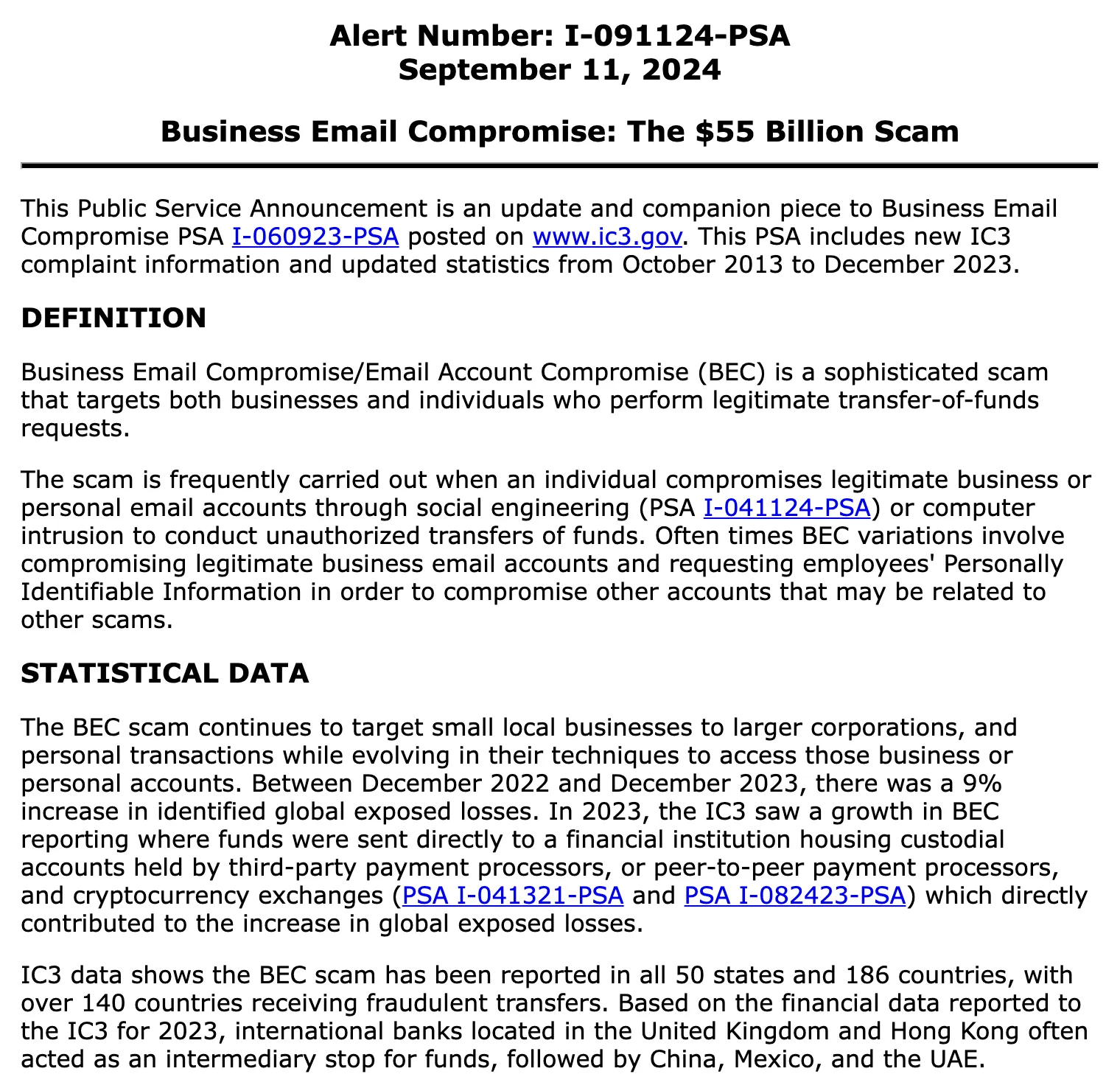
The FBI's first prevention tip is to use secondary channels or two-factor authentication to verify any change in account details. Confirm a change by calling a contact you already know, on a number you already had, never one supplied in the message.
A switch from wire to crypto late in the deal
A supplier who quoted, invoiced and took a deposit by wire, then asks for the balance in USDT "because the bank is slow" or "because of new rules", deserves a direct question. Real policy changes do not push buyers towards a method whose yuan conversion is banned in the supplier's own country.
The wallet belongs to someone else
The address is said to belong to the boss, a "finance partner", a cousin in Hong Kong or a dealer. Paying a third party breaks the link between your money and the company on your contract and invoice. If the third party is a U商 ("U merchant", an OTC dealer who buys and sells USDT) or a 承兑 desk (chengdui, an operation that converts crypto into yuan for a fee), you may be feeding a chain whose other end is fraud money.
Urgency and pressure
"Price only valid today." "The container leaves tomorrow; pay now or lose the slot." "Our account is frozen, send it again to this address." Pressure is designed to stop you verifying. The last line is worth knowing: 冻卡 (dongka, a frozen bank card) is a real and common problem in China, which is exactly why scammers borrow it as a story.
Requests to pay again
If the supplier says your USDT "didn't arrive", look up the transaction on a public block explorer using the transaction hash. A confirmed transfer to the address they gave you arrived. A request to re-send, rather than investigate, is a warning.
Unusual networks, tokens or links
Being asked to send on an unfamiliar network, to use a token other than USDT, or to "activate", "verify" or "authorize" a wallet through a link points to a wallet-draining scam rather than a payment. A genuine supplier needs only an address and a network name.
Red flags in documents and customs
The invoice won't match the payment
Some sellers propose a lower invoice for customs, with the balance paid in USDT. That is customs undervaluation. As importer of record you usually carry the duty, penalties and risk of seizure. Refuse it.
No company invoice, or one from a different entity
A genuine supplier can issue a commercial invoice from the company you signed with. An invoice from another company, a personal name or no invoice at all means you will struggle to prove what you paid for and to whom.
"Don't mention crypto"
Any suggestion that you leave the payment method out of your records, describe the transfer as something else or keep it from your bank is a request to help evade checks. This site does not give guidance on that, and neither should anyone you do business with.
Red flags about payment agents
Some buyers are steered to an agent who will "handle payment to China". Signs that the agent is an informal USDT dealer rather than a regulated payment provider:
- Personal accounts. You are told to pay a personal bank account, or a company that has nothing to do with the trade.
- One rate, no fees, no paperwork. A regulated provider identifies you, asks about the trade and shows a fee and a rate. An informal one quotes a single number and asks nothing.
- Payment split into many small amounts. Splitting transfers to stay under reporting thresholds is a classic money-laundering pattern.
- No regulator you can check. The agent cannot name a licensing regulator, or the name and licence number do not match the regulator's public register.
- Yuan arrives at the supplier from strangers. If your supplier says the yuan came from several unknown individuals, the agent is probably converting through P2P (peer-to-peer) markets, with the frozen-account risk that brings.
- "Guarantee" marketplaces. Some USDT channels are run through online marketplaces that promise to stand behind deals. US authorities have described one such network in detail.
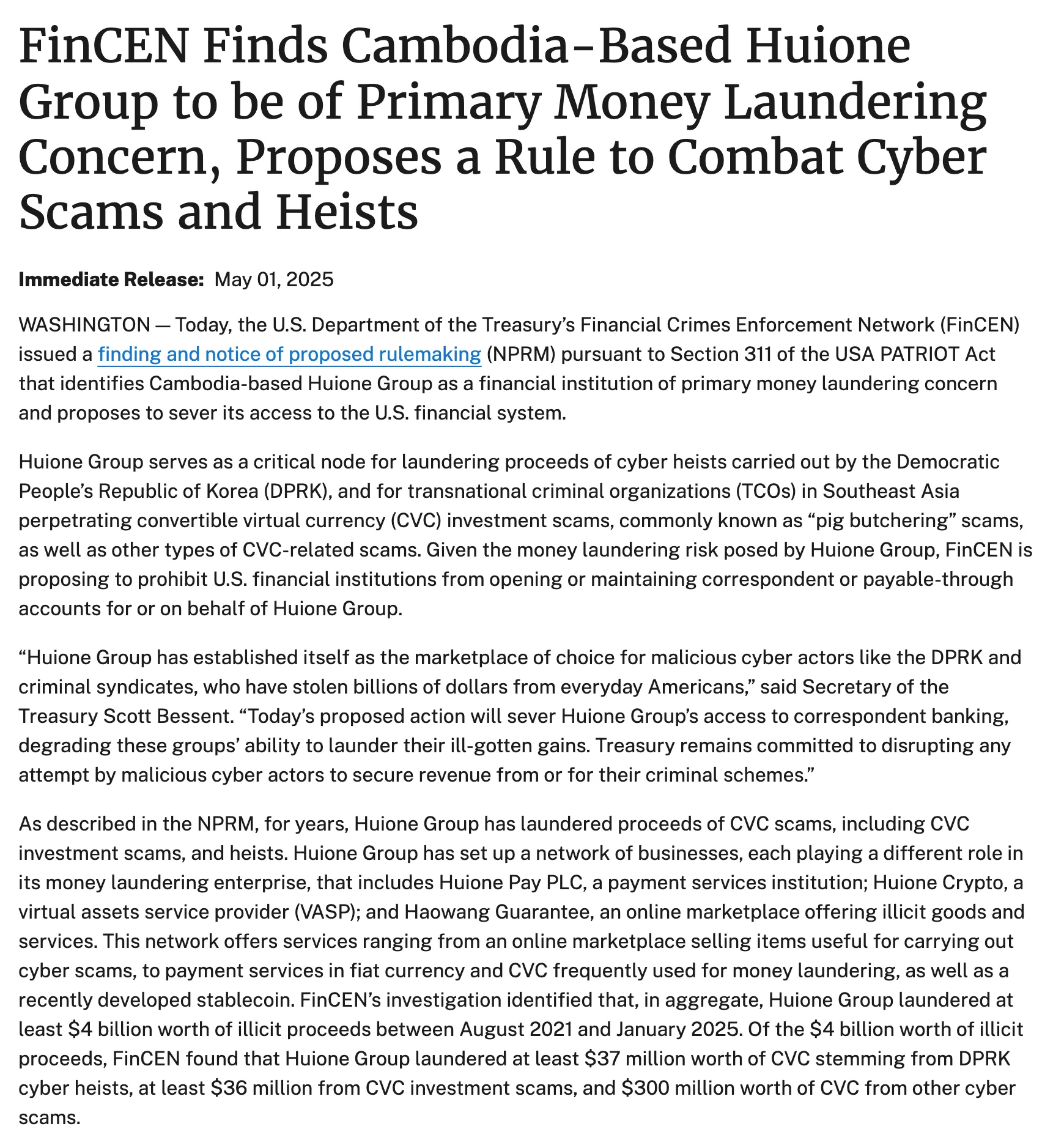
You will rarely know whose network an informal agent plugs into. That uncertainty is the risk.
Why the Chinese side makes these risks worse
Mainland China prohibits exchanging fiat currency for virtual currency. The current rule, issued by the People's Bank of China and seven other agencies as Yinfa [2026] No. 42 on February 6, 2026, says such business is strictly prohibited, and that civil acts in virtual-currency investment that violate public order and good morals are void, with losses borne by those involved (PBoC).
Chinese authorities also prosecute the people who move fraud money through crypto. Typical cases released by the Supreme People's Court, Supreme People's Procuratorate and Ministry of Public Security on July 28, 2025 include a defendant who bought up bank cards and payment accounts, moved more than CNY 6.51 million of fraud proceeds by buying virtual currency, and was sentenced to seven years for fraud (Supreme People's Court). In December 2023 prosecutors said that using virtual currency to convert between foreign currency and yuan is an important link in illegal currency trading (China Daily).
What this means for a buyer: when a USDT-paid deal goes wrong, the people best placed to help, Chinese banks, courts and police, are dealing with an activity the state treats as illegal. Some of your USDT may also end up as 黑U ("black U", USDT that has passed through fraud or laundering) or meet some along the way, leading to freezes you cannot see or fix.
A worked example: spotting a diversion attempt
A hypothetical sequence, to show how the signs stack up:
- You have bought from a Shenzhen supplier twice, paying by wire. A USD 38,000 balance is due Friday.
- On Wednesday an email from the usual sales contact says the company "now settles in USDT because of new bank rules" and gives a Tron address. Red flag: late switch, new instructions by email.
- When you hesitate, a second email says the price rises 4% if payment is not made by Thursday. Red flag: urgency.
- You call the sales contact on the number saved from your first order. She knows nothing about the change. The email came from a look-alike domain with one letter swapped.
The fix cost you one phone call. Had you paid, the USDT would have been gone in minutes, with no bank to ask for a recall.
What to do if you have already paid
- Act fast. If the payment started as a bank transfer or card payment to buy the USDT, contact that institution immediately; the FBI's advice for fraudulent transfers is to request a recall at once.
- Keep everything. Transaction hash, addresses, emails with full headers, chat logs, invoices and call records.
- Report it. To your local police and, in the US, to the FBI at ic3.gov. If the USDT went to an address at an exchange, tell that exchange; it may be able to act on a law-enforcement request.
- Do not pay "recovery" services that contact you promising to get the money back for a fee. The FBI has warned that fraudsters posing as lawyers target crypto-scam victims this way, sometimes claiming to work with government agencies (FBI IC3, June 24, 2024).
A short checklist before you pay
| Check | Why |
|---|---|
| Payee on the wallet request matches the contract and invoice | Breaks payment-diversion fraud |
| Address confirmed by voice with a known contact, on a known number | Email and WeChat accounts get hijacked |
| Small test transfer, confirmed received by the supplier | Catches wrong networks and addresses |
| Invoice shows the full amount actually paid | Keeps customs and tax records consistent |
| Your bank, accountant and lawyer know the method | Local rules on crypto and import payments differ |
| A wire or regulated provider was offered and refused for a reason you understand | Most legitimate suppliers can accept a wire |
None of this makes a USDT payment safe; it reduces specific risks. Compare routes on the USDT vs wire vs agents page, read the risks to the buyer, check the live USDT to CNY rate if a quote looks odd, and see our risk page. Take legal and tax advice in your own country before paying a supplier in crypto.
Frequently asked questions
How can I verify a Chinese supplier's USDT wallet address? Call a contact you already know on a number you already had, read the address back character by character, and send a small test amount that the supplier confirms in writing. Never verify through the channel that delivered the new address.
My supplier says the USDT never arrived. What should I do? Look up the transaction hash on a public block explorer. If it shows as confirmed to the address they gave you, it arrived. Do not send it again; ask them to check the address they control.
Is a payment agent who accepts dollars and pays yuan legitimate? It can be, if it is licensed and you can confirm the licence on the regulator's public register. If it pays the supplier from personal accounts or uses USDT in between, it carries the same risks as paying in USDT yourself.
Can I get USDT back after a payment-diversion scam? Rarely. Report quickly to the police and, in the US, to IC3. If the funds reached an exchange, a law-enforcement request may lead to a freeze, but there is no reversal button.
Is it a red flag if the supplier offers a discount for USDT? Not on its own, but ask where the discount comes from and make sure the invoice shows what you actually paid. A discount tied to a lower invoice for customs is a request to undervalue.
Sources
- FBI IC3, "Business Email Compromise: The $55 Billion Scam," I-091124-PSA, September 11, 2024: https://www.ic3.gov/PSA/2024/PSA240911
- FBI IC3, "Fictitious Law Firms Targeting Cryptocurrency Scam Victims Offering to Recover Funds," I-062424-PSA, June 24, 2024: https://www.ic3.gov/PSA/2024/PSA240624
- FinCEN, "FinCEN Finds Cambodia-Based Huione Group to be of Primary Money Laundering Concern," May 1, 2025: https://www.fincen.gov/news/news-releases/fincen-finds-cambodia-based-huione-group-be-primary-money-laundering-concern
- People's Bank of China et al., Yinfa [2026] No. 42, February 6, 2026: https://www.pbc.gov.cn/tiaofasi/144941/3581332/2026020619591971323/index.html
- Supreme People's Court, SPP and MPS typical cases on assisting online crime, July 28, 2025: https://www.court.gov.cn/zixun/xiangqing/472111.html
- China Daily, SPP and SAFE officials on typical foreign exchange crime cases, December 27, 2023: https://cn.chinadaily.com.cn/a/202312/27/WS658b9022a310c2083e414bdd.html