In this article · 13 sections
- Can a USDT payment be reversed if the supplier doesn't ship?
- Would a Chinese court help? The void-contract problem
- What happens when the supplier's bank card is frozen
- Tainted USDT ("black U") and frozen addresses
- Sanctions: your obligations don't change because it is crypto
- Customs and tax: when the invoice doesn't match the payment
- Address substitution and email takeover
- Rate and top-up risk
- A worked example: how one freeze turns into a loss
- Summary table: who bears each risk
- Questions to settle with the supplier before paying
- Frequently asked questions
- Sources
When you pay a Chinese supplier in USDT, almost every risk that a bank wire would have absorbed lands on you. A confirmed transfer cannot be reversed, nobody verifies who controls the receiving address, a Chinese court may treat the deal as unprotected because the yuan conversion is banned, and the supplier's bank account can be frozen after they sell your USDT. At home, your customs, tax and sanctions records may not line up with what you actually paid.
This page takes those risks one at a time, with the official sources behind each, a worked example and the questions to settle before you pay. It does not tell you how to manage them legally in your own country; for that, take local legal and tax advice.
Can a USDT payment be reversed if the supplier doesn't ship?
No. Once a USDT transfer is confirmed on the blockchain, you, your bank and the network cannot reverse it. Compare that with the tools buyers normally rely on:
- Bank wires. The receiving bank has identified the account holder, and a sending bank can ask for a recall. The FBI's advice to fraud victims starts there: contact your financial institution immediately and request a recall (FBI IC3, September 11, 2024). Recalls do not always work, but the route exists.
- Letters of credit and documentary collections. Payment is tied to shipping documents presented through banks.
- Card and marketplace payments. Many B2B platforms run trade-assurance or escrow programs with dispute processes.
With USDT you have none of that. If the goods never ship, arrive defective, or the address belonged to a criminal who took over the supplier's email, your remedy is negotiation or a lawsuit, not a reversal.
Tether, the issuer, can freeze tokens at specific addresses and does so when law enforcement asks: in January 2026 it froze about USD 182 million across five Tron addresses after a formal request (The Block, January 12, 2026). That power exists for its compliance with investigations and sanctions. Do not count on it to recover a commercial payment.
Would a Chinese court help? The void-contract problem
Mainland China's current rule on crypto, Yinfa [2026] No. 42 of February 6, 2026, issued by the People's Bank of China (PBoC) and seven other agencies, strictly prohibits exchanging fiat currency for virtual currency inside China. Its clause 19 adds a civil-law consequence that matters to anyone in a dispute.
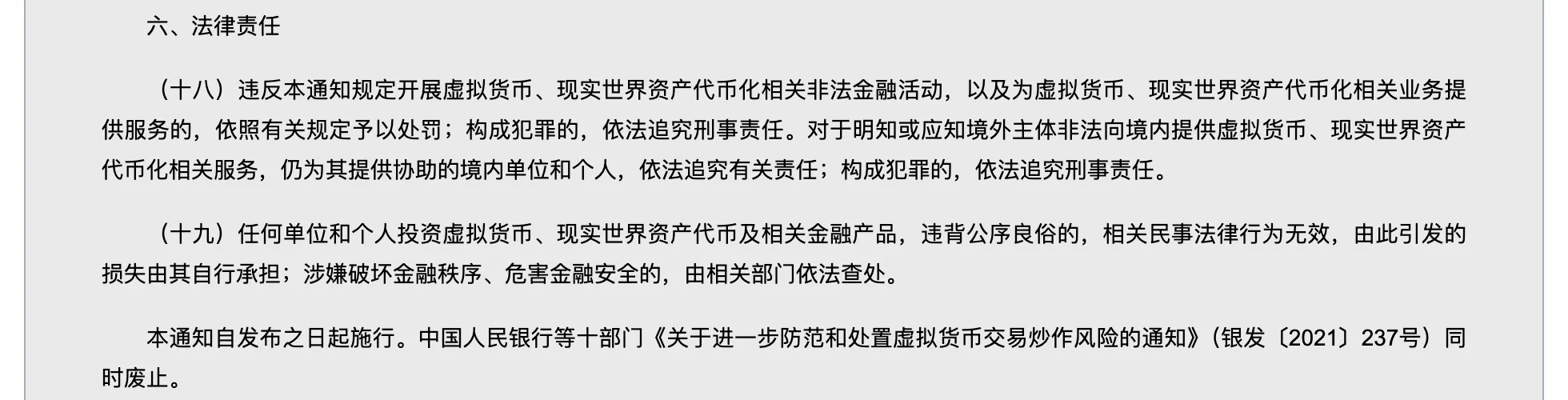
The earlier notice it replaced, Yinfa [2021] No. 237, contained the same principle (PBoC, 2021). How a Chinese court would treat a sale-of-goods contract that was merely paid in USDT depends on the facts, and outcomes vary. The practical point is simple: the payment method hands the supplier a possible argument and weakens your position in any Chinese proceeding. This is not legal advice.
What happens when the supplier's bank card is frozen
The supplier's risk becomes yours. To turn your USDT into yuan, the supplier or a dealer sells it on a peer-to-peer (P2P) market, and a stranger pays yuan into the supplier's Chinese bank card, Alipay (Ant Group's payment app) or WeChat Pay account. If that yuan came, a few steps back, from a fraud victim, police can freeze the receiving account. Chinese traders call this 冻卡 (dongka, a frozen bank card).
Freezes are common because Chinese authorities chase fraud money hard. The Anti-Telecom and Online Fraud Law, adopted on September 2, 2022 and in force since December 1, 2022, requires banks and payment institutions to run customer due diligence and risk controls to stop accounts being used for fraud (Xinhua, September 2, 2022). Courts publish cases showing how crypto fits into fraud chains.
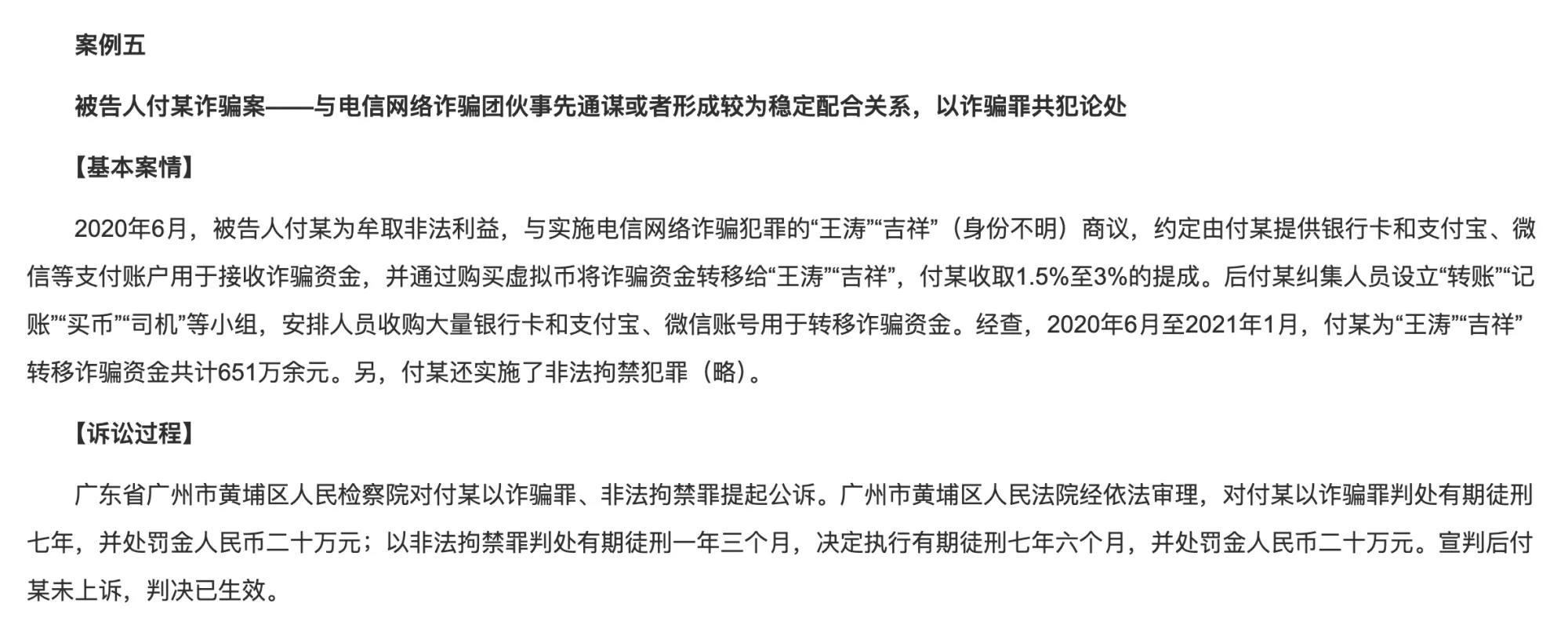
What a freeze means for you as the buyer:
- Delays. A supplier with a frozen account may stop production or hold your shipment until the account is released, which can take weeks or months.
- Requests to pay again. "Our account was frozen, please send the payment again to this new address" is both a real situation and a classic scam line, and you cannot easily tell which.
- Investigation exposure. If police trace funds through the supplier, your transaction and chat history may end up in a file you never see.
The frozen bank cards guide explains how these freezes work from the Chinese side.
Tainted USDT ("black U") and frozen addresses
Chinese traders use 黑U ("black U") for USDT that has passed through scams, gambling or laundering. Tainted coins cause trouble downstream: freezes of the bank cards that receive yuan for them and, at the token level, address blacklisting by Tether. A buyer who acquires USDT through a regulated channel at home reduces, but does not remove, the chance of being on either end of this, because you cannot control who buys the USDT from your supplier.
Sanctions: your obligations don't change because it is crypto
If you are a US person, or otherwise under US sanctions jurisdiction, paying in a stablecoin does not relax anything. The US Treasury's Office of Foreign Assets Control (OFAC) says so plainly.
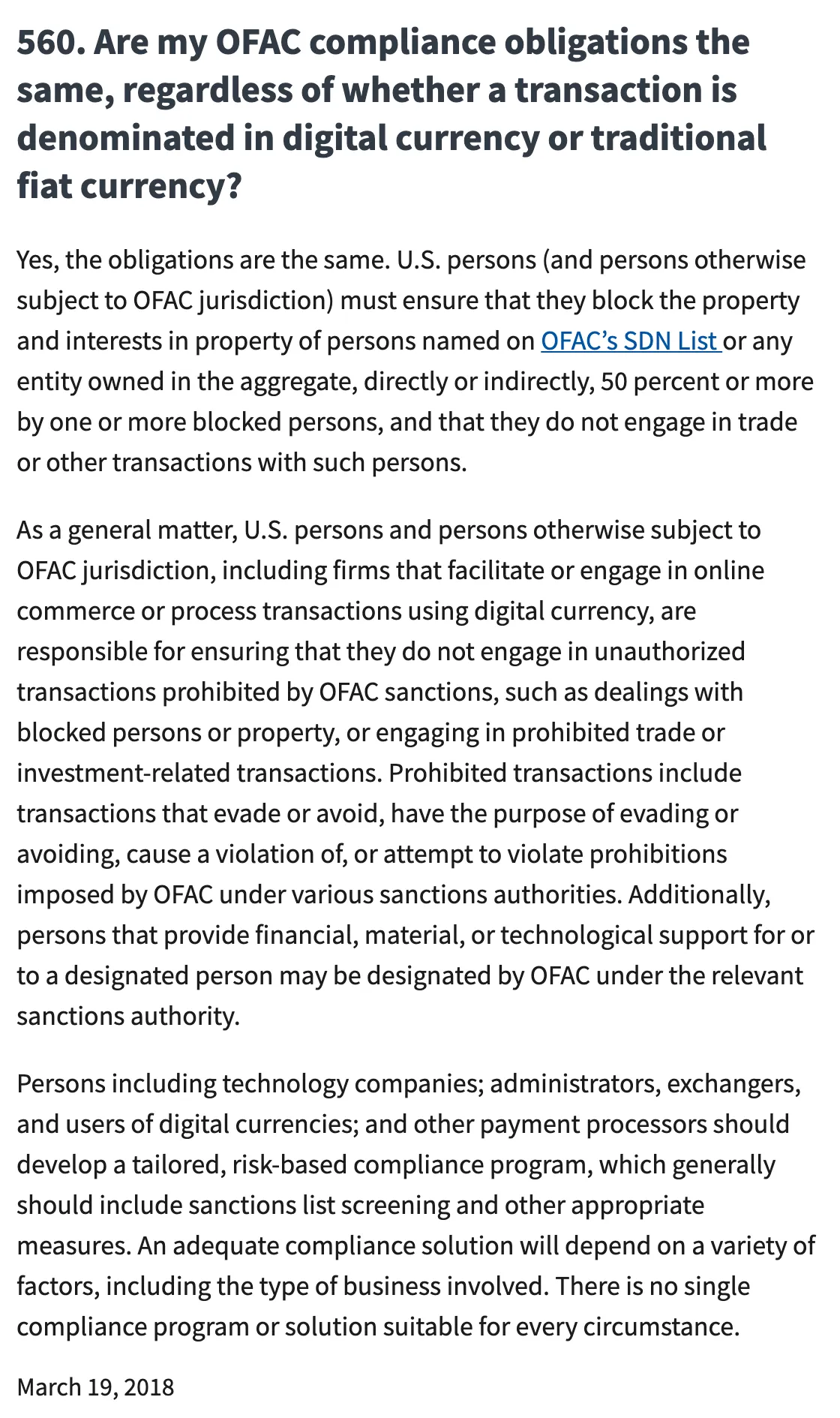
With a wire, your bank screens the payee for you. With USDT you are sending to an address whose owner you may never learn, and the yuan side runs through dealers you never see. If any of them is a blocked person, the exposure is yours. Other countries have their own sanctions regimes; ask your adviser how they apply to crypto payments.
Customs and tax: when the invoice doesn't match the payment
Customs authorities value most imports on what you paid. In the United States, for example, the transaction value of imported goods is "the price actually paid or payable" for them, plus certain additions (19 U.S.C. § 1401a). USDT complicates every part of that.
Amount and currency
Your commercial invoice is probably in dollars. What you sent was USDT, which you bought at some price, plus network and platform fees. Your accountant has to decide how to record that cost. If the supplier offers a "discount" for paying in USDT, the invoice and the amount actually paid may differ, and the declared value should follow what was really paid.
Payee
The invoice names a company. The USDT went to an address that may belong to an individual, a broker or a stranger. If an auditor asks you to prove payment to the named seller, a blockchain record between two anonymous addresses is weak evidence. Keep the contract, the address confirmation, the transaction hash and the supplier's written receipt together.
Split payments and undervaluation
Some suppliers or agents suggest paying part by wire against a lower invoice and the rest in USDT. That is customs undervaluation, and the importer of record usually bears the duty, penalties and possible seizure. Do not agree to it. This site does not give guidance on structuring payments around customs, tax or anti-money-laundering checks.
Your bank's view
Your own bank may ask where the money that bought the USDT went, or may restrict accounts linked to crypto platforms. Repeated crypto transfers to unknown counterparties look like a money-laundering risk indicator to many banks.
Address substitution and email takeover
Most supplier-payment fraud does not involve the supplier at all. Someone gets into an email thread or a WeChat account (China's dominant messaging app) and sends "updated" payment details just before a large payment. The FBI's Internet Crime Complaint Center counts USD 55.5 billion in exposed losses from business email compromise between October 2013 and December 2023, and notes growth in cases where funds went to crypto exchanges (FBI IC3). With a wire, a changed beneficiary name sometimes triggers a bank check. With USDT, a changed address is just another string of characters. Verify every address through a channel you set up yourself.
Rate and top-up risk
Even an honest deal can cost more than expected. The supplier converts at the P2P market price, which can sit above or below the official exchange rate, and larger amounts often get a different price from small ones. If the price moves between quote and conversion, someone absorbs the difference, and suppliers sometimes ask the buyer to top up. The rate article explains which price applies, and the live USDT to CNY rate shows today's prices by order size.
A worked example: how one freeze turns into a loss
This is a hypothetical sequence, not a reported case, built from the mechanisms above.
- You pay a 30% deposit of USD 15,000 in USDT on a USD 50,000 order. The supplier sells it the same day to three P2P buyers.
- One buyer's yuan, about CNY 33,000, turns out to be fraud money. Police freeze the supplier's bank card, which also holds the rest of the deposit.
- The supplier says production cannot start until the card is released and asks you to send the deposit again to a relative's address.
- You now face three bad options: pay USD 15,000 again with no way to check the story, wait an unknown time, or walk away and try to recover the first USD 15,000 from a supplier whose account is frozen, under a contract a Chinese court may treat as void.
With a wire to the company's account, step 2 is very unlikely: the yuan would come from the supplier's own bank conversion, not from strangers.
Summary table: who bears each risk
| Risk | What happens | Who bears it |
|---|---|---|
| No reversal | Funds gone if goods don't arrive | Buyer |
| Void or weak contract in China | Little protection in a Chinese court | Mainly buyer |
| Frozen supplier account (冻卡) | Delay, requests to pay again | Supplier first, then buyer |
| Tainted USDT (黑U) | Frozen cards or addresses downstream | Whoever holds the funds |
| Sanctions exposure | Payment reaches a blocked person | Payer |
| Invoice or customs mismatch | Audit questions, duty, penalties | Importer of record |
| Address substitution | Payment goes to a criminal | Buyer |
| Rate moves | Supplier asks for a top-up | Negotiated, often buyer |
Questions to settle with the supplier before paying
- Will you accept a wire to the company account on the contract instead? If not, why not?
- Whose address is this, and will you confirm it on a call?
- Who converts the USDT, and through which accounts does the yuan arrive?
- If your account is frozen, will you still ship, and by when?
- Will the invoice show the full amount paid?
- Will you sign a receipt naming the transaction hash and the USDT amount?
No checklist removes these risks. Bank wires, letters of credit and regulated payment providers exist because they move some of them onto institutions. Compare routes on the USDT vs wire vs agents page, read the red flags, and see our general risk page.
Frequently asked questions
Is paying a supplier in USDT riskier than a bank wire? For the buyer, yes, in most respects: no recall, no verified payee, weaker legal standing in China, frozen-account risk on the supplier's side and a thinner paper trail at home. It is usually faster and can be cheaper to send.
Can Tether freeze or return my USDT if I was scammed? Tether freezes addresses in response to law-enforcement requests and sanctions listings. It does not act as a dispute service for commercial deals. If you were defrauded, report it to the police and, in the US, to the FBI's IC3 as soon as possible.
What does a frozen bank card in China mean for my order? The supplier cannot use the money in that account until police release it, which can take weeks or months. Expect delays, and treat any request to resend payment to a new address as a possible scam.
Do I need to declare the USDT amount or the invoice amount to customs? Customs generally values goods on the price actually paid or payable. If the two differ, take advice from a customs broker or lawyer in your country; do not accept a split or lowered invoice.
Does a test transfer protect me? It protects against a wrong address or network. It does nothing against a supplier who takes the full payment and fails to ship.
Sources
- People's Bank of China et al., Yinfa [2026] No. 42, February 6, 2026: https://www.pbc.gov.cn/tiaofasi/144941/3581332/2026020619591971323/index.html
- People's Bank of China et al., Yinfa [2021] No. 237, September 15, 2021 (repealed): https://www.pbc.gov.cn/tiaofasi/144941/3581332/4348658/index.html
- Xinhua, Anti-Telecom and Online Fraud Law adopted, September 2, 2022: https://www.news.cn/politics/2022-09/02/c_1128972095.htm
- Supreme People's Court, SPP and MPS typical cases on assisting online crime, July 28, 2025: https://www.court.gov.cn/zixun/xiangqing/472111.html
- The Block, "Tether freezes $182 million in USDT tied to five Tron addresses," January 12, 2026: https://www.theblock.co/news/markets/2026-01-12-tether-freezes-182-million-usdt-385051
- US Treasury OFAC, FAQ 560, March 19, 2018: https://ofac.treasury.gov/faqs/560
- FBI IC3, "Business Email Compromise: The $55 Billion Scam," September 11, 2024: https://www.ic3.gov/PSA/2024/PSA240911
- 19 U.S.C. § 1401a, value of imported merchandise: https://www.law.cornell.edu/uscode/text/19/1401a