In this article · 9 sections
- Where does the USDT/CNY price come from?
- Buy price vs sell price: which one applies to your supplier?
- Why does the order size change the USDT rate?
- How the USDT price compares with the official yuan rate
- Worked examples: three suppliers, three prices
- What moves the price between the quote and the conversion
- How to check a supplier's quoted rate, step by step
- Frequently asked questions
- Sources
A supplier who converts the USDT you send into yuan receives roughly the P2P sell price: the number of yuan a USDT seller gets per USDT on China's peer-to-peer market at that moment, for a conversion of that size. It is not the official dollar exchange rate, it is not the price quoted for buying USDT, and it can differ by a percent or more between a small conversion and a large one. Here is where it stands now across three order sizes:
| Order of | Highest sell | Lowest buy |
|---|---|---|
| CNY 5,000Small | 6.630HTX | 6.630Binance |
| CNY 50,000Medium | 6.630Binance | 6.630Binance |
| CNY 300,000Large | 6.640Binance | 6.630Binance |
Live data, CNY per USDT · updated 20:18 Beijing time · premium −0.85% · full board
The rest of this page explains where those numbers come from, why order size matters, and how to check a rate your supplier quotes you.
Where does the USDT/CNY price come from?
Exchanging yuan for crypto is banned in mainland China under Yinfa [2026] No. 42, the February 2026 notice of the People's Bank of China and seven other agencies (PBoC). So there is no official USDT/CNY market. What exists instead is a P2P (peer-to-peer) market: individuals and dealers post ads on large exchanges' P2P boards offering to buy or sell USDT for yuan, paid by bank transfer, Alipay or WeChat Pay (China's two dominant payment apps). Dealers who do this full-time are called U商 ("U merchants").
Every ad carries its own price, a minimum and maximum order in yuan, and the payment methods it accepts. The Alipay, WeChat and bank card guide explains the ad terms.
Every 3 minutes, coinkiki reads the CNY ads that Binance, OKX and HTX show on their public P2P pages. For each order size it keeps the ads that can take an order of that size from advertisers with at least 95% order completion and at least 50 completed orders, and shows the middle price of the best 5 of them. These numbers come from live ads, not from anyone's choice. The full method is in how coinkiki calculates.
Buy price vs sell price: which one applies to your supplier?
The site shows two sides, named from the point of view of the person trading USDT:
- Buy price = CNY paid per USDT. What someone pays in yuan to get one USDT.
- Sell price = CNY received per USDT. What someone receives in yuan for giving up one USDT.
Your supplier is a seller. They hold USDT and want yuan, so they receive roughly the sell price. If a supplier quotes you using the buy price, or the official exchange rate, the yuan they actually receive will differ from the quote. Normally the buy price sits above the sell price, and the gap is part of what dealers earn, but on a given day the best ads on each side can sit close together or even cross, because the best-priced ads often come with large minimum orders.
The two screenshots below were taken a few minutes apart on 10 November 2026 and show both sides of Binance's CNY board.
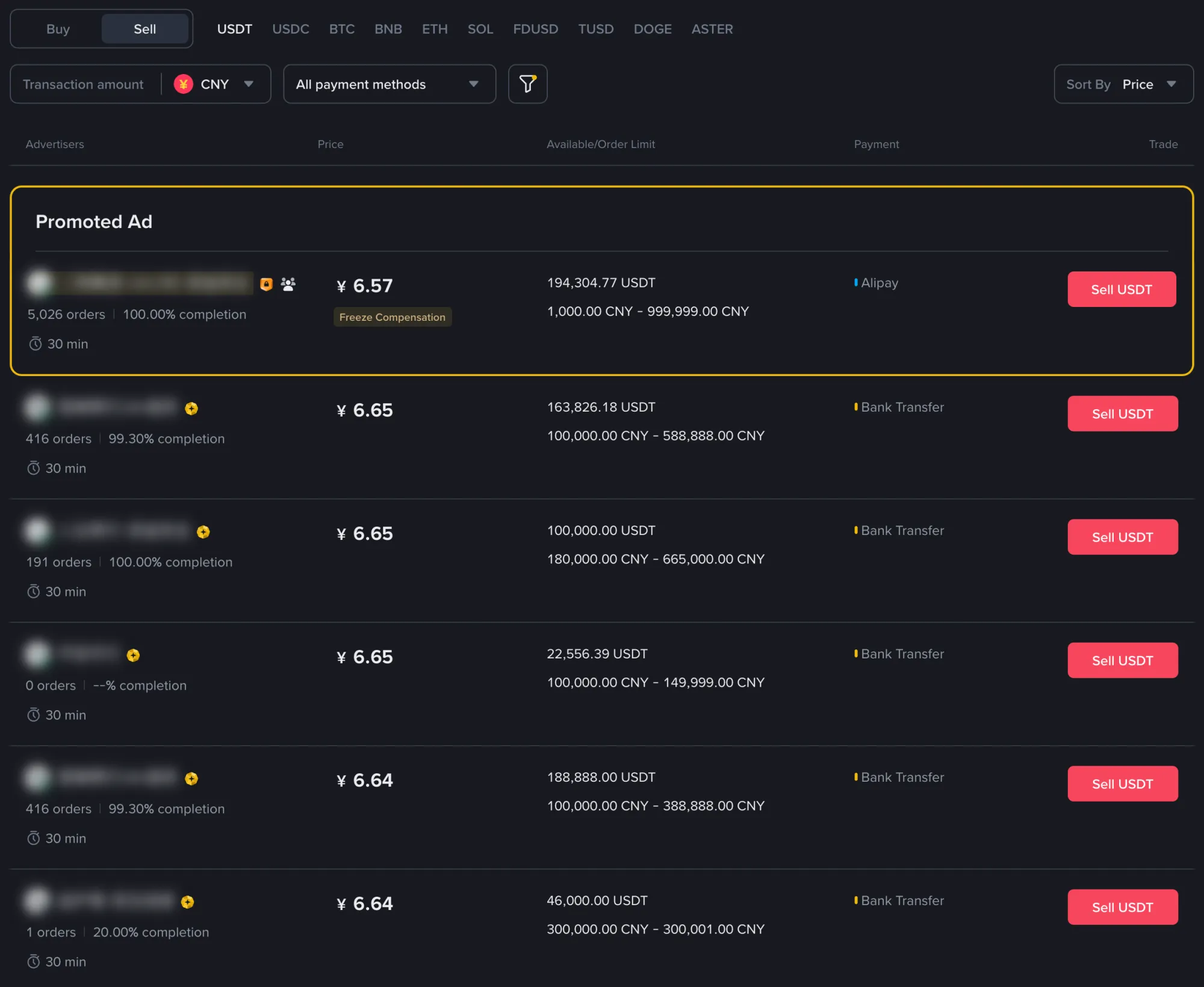
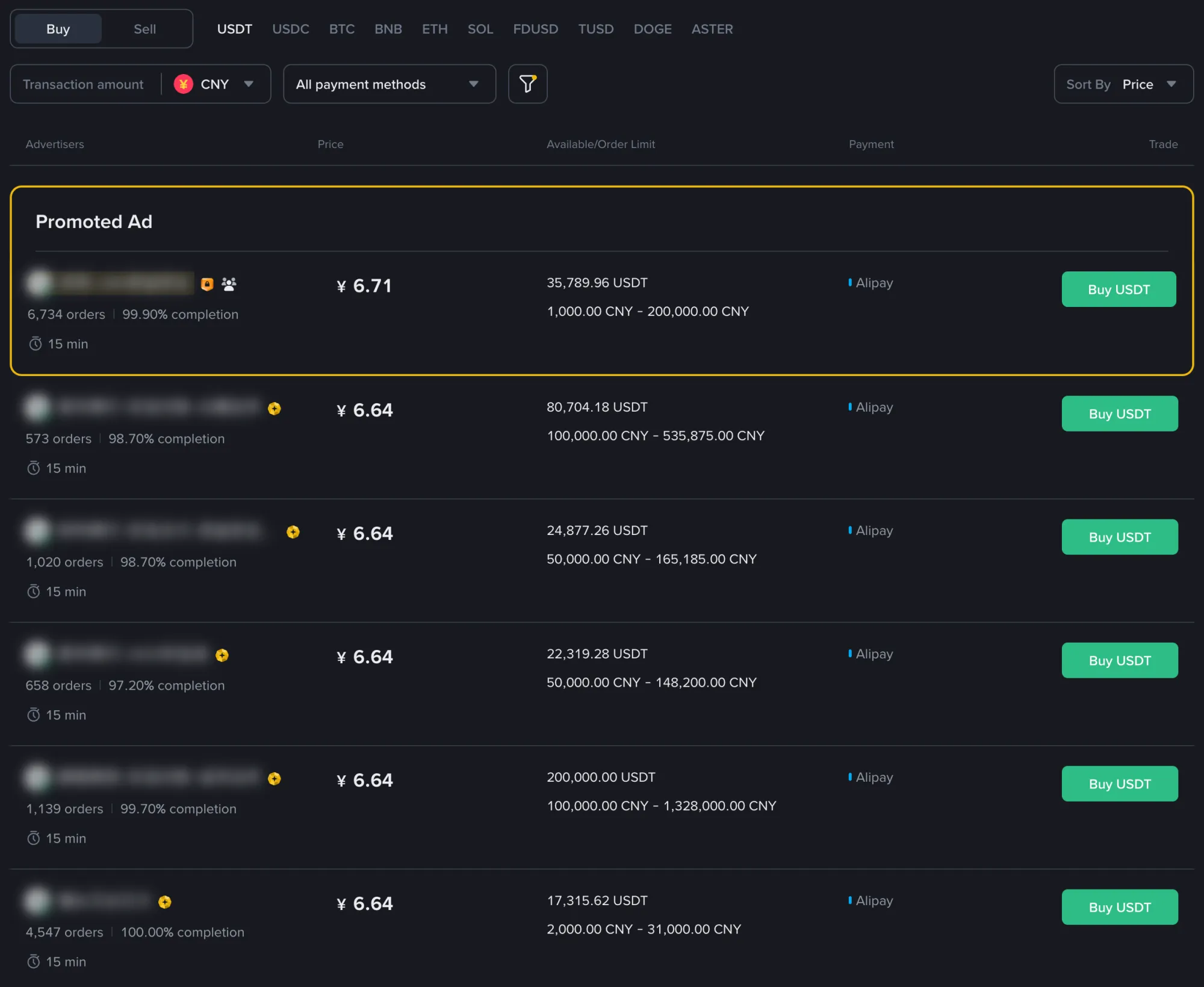
On 10 November, when these screenshots were taken, a supplier selling CNY 150,000 worth of USDT by bank transfer could get about 6.65; a supplier selling CNY 20,000 worth through the ad shown that accepted small orders would have got 6.57. The gap of 0.08 yuan per USDT is about 1.2% of the payment.
Why does the order size change the USDT rate?
Coinkiki shows three tiers, CNY 5,000, CNY 50,000 and CNY 300,000. Each is the yuan value of a single conversion. Prices differ between them for practical reasons.
Not every ad can take every order
Every P2P ad has a minimum and maximum. As the screenshots show, many of the best-priced sell ads only take orders of CNY 100,000 or more, while others cap out at a few tens of thousands. At CNY 5,000, a supplier is shut out of the big dealers' ads; at CNY 300,000, the pool of ads that can take the whole order in one trade shrinks again. Large dealers sometimes compete for volume and pay more, sometimes less.
Large yuan payments are riskier for the counterparty
When a supplier sells USDT, the buyer on the other side sends yuan into the supplier's bank account. Large payments between strangers attract bank scrutiny and carry a higher chance that the funds are later traced to fraud, leading to a freeze. Chinese traders call that 冻卡 (dongka, frozen bank card). Dealers price that risk in, and some advertise compensation if a freeze happens, like the "Freeze Compensation" label in the sell screenshot. See why bank cards get frozen.
Small orders carry fixed effort
A small order takes the same chat, payment check and risk review as a mid-sized one. Some advertisers widen their price on very small orders to compensate.
What that means in practice
| Order size | Who typically trades here | What to expect |
|---|---|---|
| CNY 5,000 | Individuals, small top-ups | Many ads; the best large-dealer prices are out of reach |
| CNY 50,000 | Small businesses, regular traders | Usually the deepest, most competitive tier |
| CNY 300,000 | Dealers, larger supplier payments | Fewer ads; price and fill vary more |
These are tendencies, not rules. The live rate page and the data page show the actual gap between tiers.
Splitting a payment
A supplier converting a large payment may sell it in several pieces. That means more counterparties, more incoming transfers from strangers and more chances that one of them is tainted money. This site does not advise structuring transactions to avoid bank or regulatory checks; splitting to stay under reporting thresholds is itself a red flag in most anti-money-laundering regimes.
How the USDT price compares with the official yuan rate
China's yuan has an onshore rate (CNY), managed around a central parity rate that the China Foreign Exchange Trade System (CFETS) publishes each business morning (the table below is stamped 9:15 China time), and an offshore rate (CNH) that trades freely in Hong Kong and other centres. The P2P price of USDT in yuan is a third, informal price.
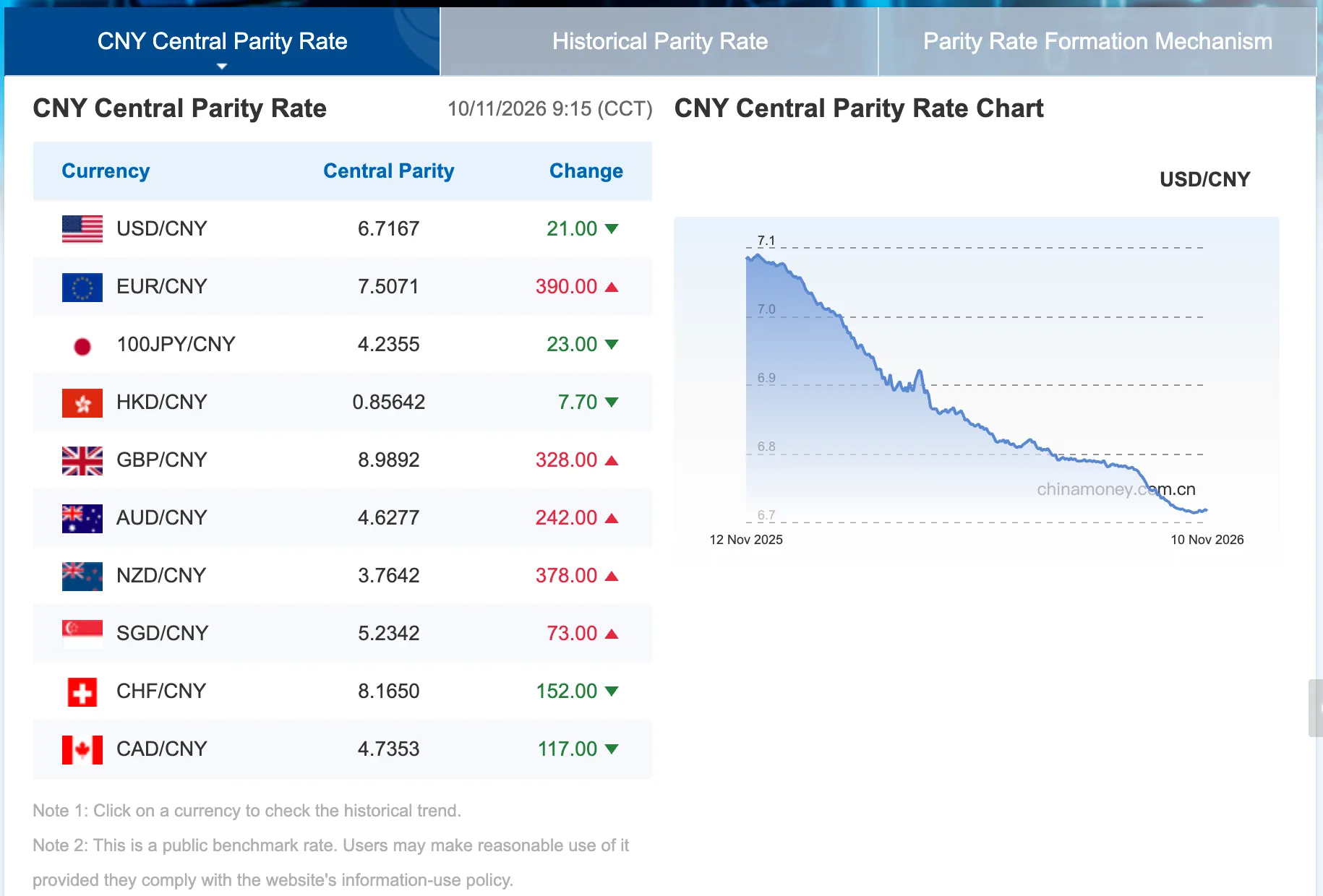
When the P2P price is above the official USD/CNY rate, USDT trades at a premium; below, at a discount. Set against that morning's central parity of 6.7167, the best large sell ads at 6.65 were about 1.0% below it, and the small-order ad at 6.57 about 2.2% below. The direction matters to your supplier:
- Premium: the supplier receives more yuan for each USDT than a bank would pay for a dollar.
- Discount: the supplier receives fewer yuan, and a wire might deliver more.
Why the premium or discount exists, and how it moves with capital-flight pressure, exchange crackdowns and demand from Chinese savers, is covered in why USDT trades at a discount or premium in China. Today's figure is on the China USDT premium page.
Worked examples: three suppliers, three prices
The prices below are hypothetical round numbers, not today's market. Use the USDT to CNY converter for live figures.
| Payment | Conversion size | Sell price assumed | Yuan received | Same dollars at a bank rate of 6.70 |
|---|---|---|---|---|
| 2,000 USDT for samples | About CNY 13,000 | 6.58 | CNY 13,160 | CNY 13,400 |
| 20,000 USDT deposit | About CNY 133,000 | 6.65 | CNY 133,000 | CNY 134,000 |
| 150,000 USDT balance | About CNY 1 million | 6.62 | CNY 993,000 | CNY 1,005,000 |
In this illustration the middle payment gets the best rate, the small one loses about 1.8% against the bank rate, and the large one about 1.2%. If a dealer converts for the supplier and keeps 0.3%, take another CNY 400 off the middle row. A supplier quoting you a "rate" should be able to tell you which of these situations they are in.
What moves the price between the quote and the conversion
- Time. P2P prices update constantly. A quote from yesterday may not hold.
- Payment method. Ads that accept bank transfer, Alipay or WeChat Pay can price differently, and some suppliers can only receive one of them.
- Market stress. During crackdown news or sharp moves in the yuan, spreads widen and large-order liquidity dries up first.
- Weekends and holidays. Banks close, but P2P keeps running with fewer active dealers.
- The supplier's own constraints. A supplier who needs yuan today takes the best ad available today.
How to check a supplier's quoted rate, step by step
- Ask the supplier how many yuan they expect to receive per USDT, and for which amount.
- Compare it with the sell price at the matching tier on the live rate page, or on the page for the exchange they use.
- Price the exact amount in the USDT to CNY converter.
- If the supplier's number is far from the market, ask why. A quote well above market may hide a charge to you; one well below may mean their dealer takes a large cut.
- Run the same invoice through the calculator on the supplier payments hub to compare with a wire.
- Agree in writing whether the invoice is fixed in dollars or in yuan, and who absorbs a move in the rate before conversion.
Price is only one input. Mainland China prohibits exchanging yuan for virtual currency, and the risks to the buyer apply however good the rate looks. Take legal and tax advice in your own country before paying this way.
Frequently asked questions
What rate does a Chinese supplier get for USDT? Roughly the P2P sell price for a conversion of their size, minus any dealer margin. It is usually close to, but not the same as, the official USD/CNY rate.
Why is the USDT price different from the bank exchange rate? Because the yuan conversion happens on an informal P2P market, not through banks. Supply, demand, crackdown news and frozen-card risk push it above or below the official rate.
Is a bigger payment always converted at a better rate? No. Mid-sized conversions often get the most competitive prices. Very small ones are shut out of large dealers' ads, and very large ones may not fit in a single ad.
Should the invoice be in dollars or yuan if I pay in USDT? That is a commercial choice, but agree it in writing. If the invoice is in yuan, you carry the rate risk; if it is in dollars, the supplier does, and may ask for a top-up when the P2P price falls.
Which exchange's price should I look at? The one your supplier or their dealer actually uses. Coinkiki shows Binance, OKX and HTX separately. This site does not suggest using any of them.
Sources
- People's Bank of China et al., Yinfa [2026] No. 42, February 6, 2026: https://www.pbc.gov.cn/tiaofasi/144941/3581332/2026020619591971323/index.html
- CFETS, CNY Central Parity Rate: https://www.chinamoney.com.cn/english/bmkcpr/
- Binance P2P, sell USDT for CNY (public ad list): https://p2p.binance.com/en/trade/sell/USDT?fiat=CNY&payment=all-payments
- Binance P2P, buy USDT with CNY (public ad list): https://p2p.binance.com/en/trade/buy/USDT?fiat=CNY&payment=all-payments