In this article · 14 sections
- How a bank wire to a Chinese supplier works
- How a USDT payment works
- What "payment agent" can mean
- Bank wire fees to China: what you actually pay
- USDT costs: the parts you don't see
- Worked example: a USD 20,000 invoice by wire and by USDT
- How long does a wire to China take?
- How fast is USDT, really?
- Payment agents: cost and timing
- Beyond price: protection, paperwork and legal status
- Which route fits which situation
- Questions to ask a payment agent
- Frequently asked questions
- Sources
On the headline numbers USDT usually looks best: a small network fee and settlement in minutes, against a bank wire's fixed fees, currency spread and a wait of hours to days. But the headline leaves out three things: the rate at which the supplier turns USDT into yuan, which can be worse than a bank's; the legal exposure on the Chinese side, where that conversion is banned; and the buyer protection you give up. Payment agents sit in between and range from licensed cross-border payment firms to informal brokers who are effectively USDT dealers under another name.
The calculator on the paying Chinese suppliers hub lets you put in an invoice amount and your own fees and compare what the supplier receives in yuan each way. This page explains the inputs and what the calculator cannot show.
How a bank wire to a Chinese supplier works
You instruct your bank to send dollars to the supplier's bank in China. The instruction travels over SWIFT, the bank messaging network, often through one or more correspondent (intermediary) banks. The supplier's bank credits dollars to the company's foreign-currency account, and the supplier converts to yuan at the bank's rate, which follows the onshore yuan (CNY). CNY trades inside mainland China around a central parity rate published each business morning by the China Foreign Exchange Trade System.
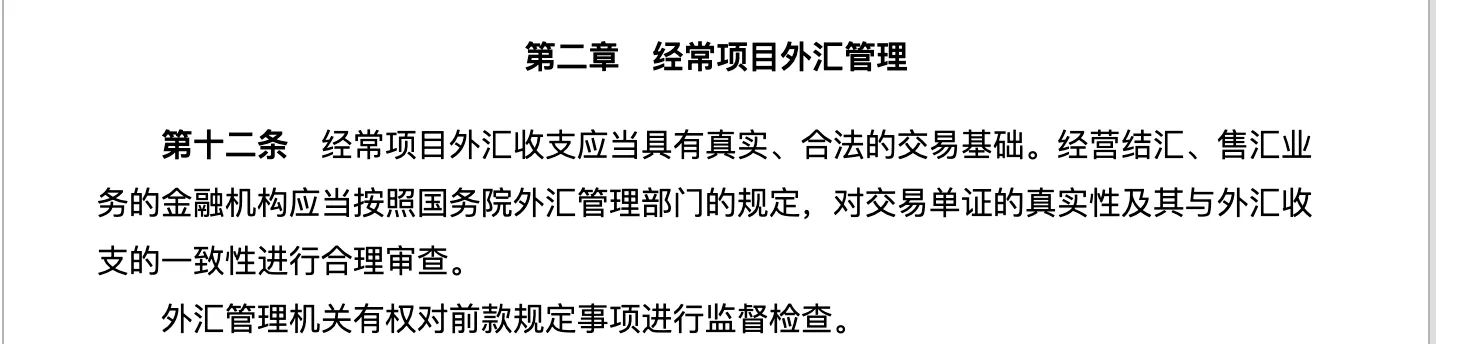
Before crediting, the Chinese bank has a legal duty to look at the paperwork. Under the State Council's foreign-exchange regulations, current-account receipts must have a real and lawful transaction basis, and banks must check that the trade documents are genuine and consistent with the money.
That review is why a wire into China sometimes waits for a contract or invoice, and it is also why the wire leaves a record every authority understands.
How a USDT payment works
You send USDT, a dollar-pegged stablecoin, to an address the supplier gives you. The supplier or a dealer sells it on a peer-to-peer (P2P) market for yuan paid into a Chinese bank card, Alipay or WeChat Pay account (China's two dominant payment apps). The step-by-step version is in how importers pay in USDT.
What "payment agent" can mean
The label covers very different businesses:
- Licensed cross-border payment providers. Regulated firms that collect your money and pay the supplier in yuan or dollars through the banking system, with identity and trade checks at both ends.
- Hong Kong or offshore intermediaries. A trading company or agent with an offshore account receives your dollars, sometimes converting to CNH (offshore yuan, which trades freely outside the mainland), and pays the supplier.
- Informal agents (代付, daifu, "pay on behalf"). Someone takes your money in one form and has yuan paid to the supplier from accounts inside China. Many are funded with USDT behind the scenes, so they carry the same legal and frozen-account risk as paying in USDT directly, with less visibility.
The test is simple: can the agent name its regulator and licence number, and does that regulator's public register confirm it?
Bank wire fees to China: what you actually pay
A wire has three cost layers.
The sending fee. Banks publish these in their fee schedules, and they vary a lot. Two published examples:
| Bank (schedule) | International payment sent online | Sent in a branch | Other charges listed |
|---|---|---|---|
| Newburyport Bank, US (business schedule effective January 1, 2026) | USD 25 in US dollars, USD 50 in foreign currency | USD 50 | USD 50 to receive an international wire |
| Bank of Scotland, UK (business international rates and charges) | GBP 15 | GBP 28 | GBP 20 correspondent bank fee for "rest of the world" payments when you choose to pay all charges |
Sources: Newburyport Bank fee schedule; Bank of Scotland Business. These illustrate the structure of the fees; they are not typical values. Check your own bank's schedule.
Who pays the charges along the way. Payments usually pass through intermediary or correspondent banks, and their charges may be taken out of the amount before it arrives. Wire forms ask you to choose a charging option. Bank of Scotland's page defines them the way most banks do: BEN, the receiver pays all charges; SHA, each side pays its own bank and the receiver also bears any bank in between; OUR, the sender pays all charges. It also warns that it has no control or visibility over which route a payment takes or what intermediaries deduct. If your invoice must arrive in full, OUR is the option that aims for that, at an extra fee.
The exchange spread. If you hold euros, pounds or another currency, your bank converts to dollars first at a rate below the mid-market rate. On the Chinese side, the supplier converts dollars to yuan at the bank's buying rate. On a large invoice, these spreads are usually the biggest cost; on a small one, the fixed fees are.
USDT costs: the parts you don't see
| Cost item | What it is | Visible to you? |
|---|---|---|
| Buying USDT | The price above USD 1 plus platform fees in your home market | Yes |
| Network fee | Paid to send on Tron or Ethereum; varies with network conditions | Yes |
| Supplier's conversion | The P2P "sell price": yuan received per USDT at that order size | Only if you ask |
| Dealer margin | If a U merchant (an OTC dealer) converts for the supplier | Rarely |
| Hidden costs | Frozen accounts, re-payments, rate moves, top-up requests | No |
The key variable is the third line. The P2P price of USDT in yuan can sit above or below the official dollar rate and differs by order size. If USDT trades at a premium, the supplier receives more yuan than a bank would pay for the same dollars; at a discount, fewer. Our China USDT premium page tracks that gap and the rate article explains the buy and sell sides.
Worked example: a USD 20,000 invoice by wire and by USDT
All figures are hypothetical, chosen to show the arithmetic. Say the supplier's bank buys dollars at 6.68 yuan, and the best P2P ad that can take a CNY 133,000 sale pays 6.63 yuan per USDT.
| Wire, OUR | Wire, SHA | USDT | |
|---|---|---|---|
| Your fees | USD 25 sending + USD 30 for OUR cover | USD 25 | About USD 40 to buy and send |
| Amount arriving | USD 20,000 | USD 19,970 if USD 30 is deducted on the way | 20,000 USDT |
| Rate to yuan | 6.68 | 6.68 | 6.63 |
| Supplier receives | CNY 133,600 | CNY 133,400 | CNY 132,600 |
| Your total outlay | USD 20,055 | USD 20,025 | USD 20,040 |
In this example both wires deliver more yuan than USDT, even though USDT cost about the same to send. Move the P2P price to 6.72, a premium, and USDT would deliver CNY 134,400 and win on yuan alone. That is why there is no general answer to "which is cheaper". It depends on the live P2P price at that size, your bank's pricing and the charges option. Check the live USDT to CNY rate and run your own numbers in the hub calculator.
How long does a wire to China take?
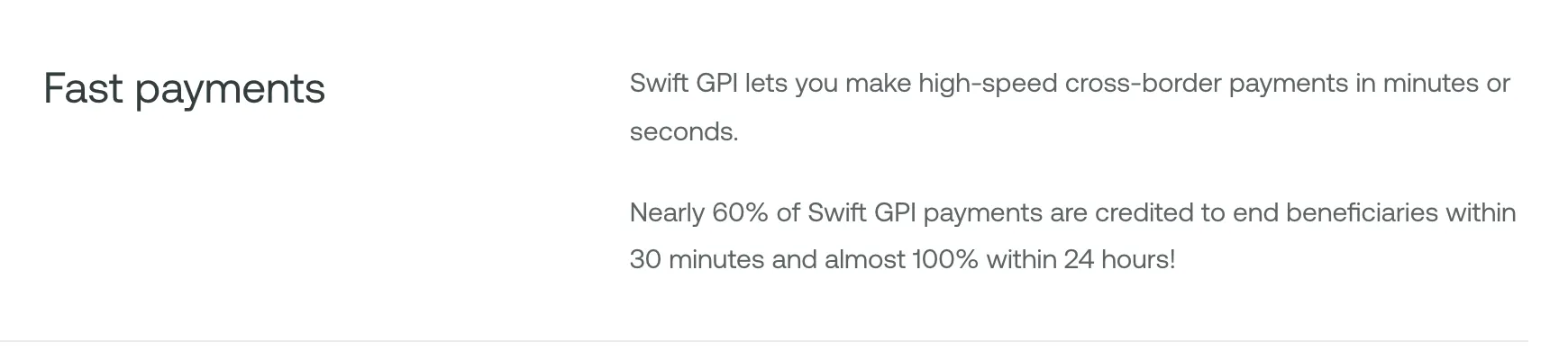
SWIFT says that nearly 60% of payments on its GPI tracking service reach the end beneficiary within 30 minutes and almost all within 24 hours.
Those are averages across the network. A wire into China can take longer for reasons that have nothing to do with SWIFT:
- Document checks. The Chinese bank may hold the funds until the supplier provides a contract or invoice that matches the payment.
- Banking days. Chinese banks follow the mainland holiday calendar. In 2026 the Spring Festival break ran from February 15 to 23 and the National Day break from October 1 to 7 (State Council holiday notice, via Xinhua). A wire sent just before either break can sit for a week.
- Time zones and cut-offs. A wire sent in the US afternoon arrives after Chinese banks have closed.
Plan for one to several business days and add the holiday calendar to your payment schedule.
How fast is USDT, really?
The transfer itself confirms in minutes, at any hour. The supplier's conversion to yuan is a separate step that can take from minutes to a day, and longer if a P2P counterparty's payment is late or an account is frozen. If the supplier needs yuan in hand before releasing goods, the true settlement time is the conversion time, not the blockchain time.
Payment agents: cost and timing
Licensed providers usually charge a percentage fee, an exchange margin or both, and should quote them, along with a delivery time, before you pay. Because they pay through Chinese banks, the same document checks and bank holidays apply as for a wire. Informal agents typically quote a single "rate" that bundles their margin, which hides the cost, and may be fast until their own accounts run into trouble. Ask any agent for the rate, the fee and the exact yuan amount the supplier will receive, in writing, before you send anything.
Beyond price: protection, paperwork and legal status
| Bank wire | USDT | Licensed provider | Informal agent | |
|---|---|---|---|---|
| Payee verified | Yes, by bank | No | Yes | Rarely |
| Recall possible | Limited | No | Limited | No |
| Paper trail for customs and tax | Strong | Weak | Strong | Weak |
| Legal status in mainland China | Ordinary trade settlement | Conversion prohibited | Ordinary, if properly licensed | Often relies on the same prohibited conversion |
| Frozen-account risk for supplier | Low | Real | Low | Real |
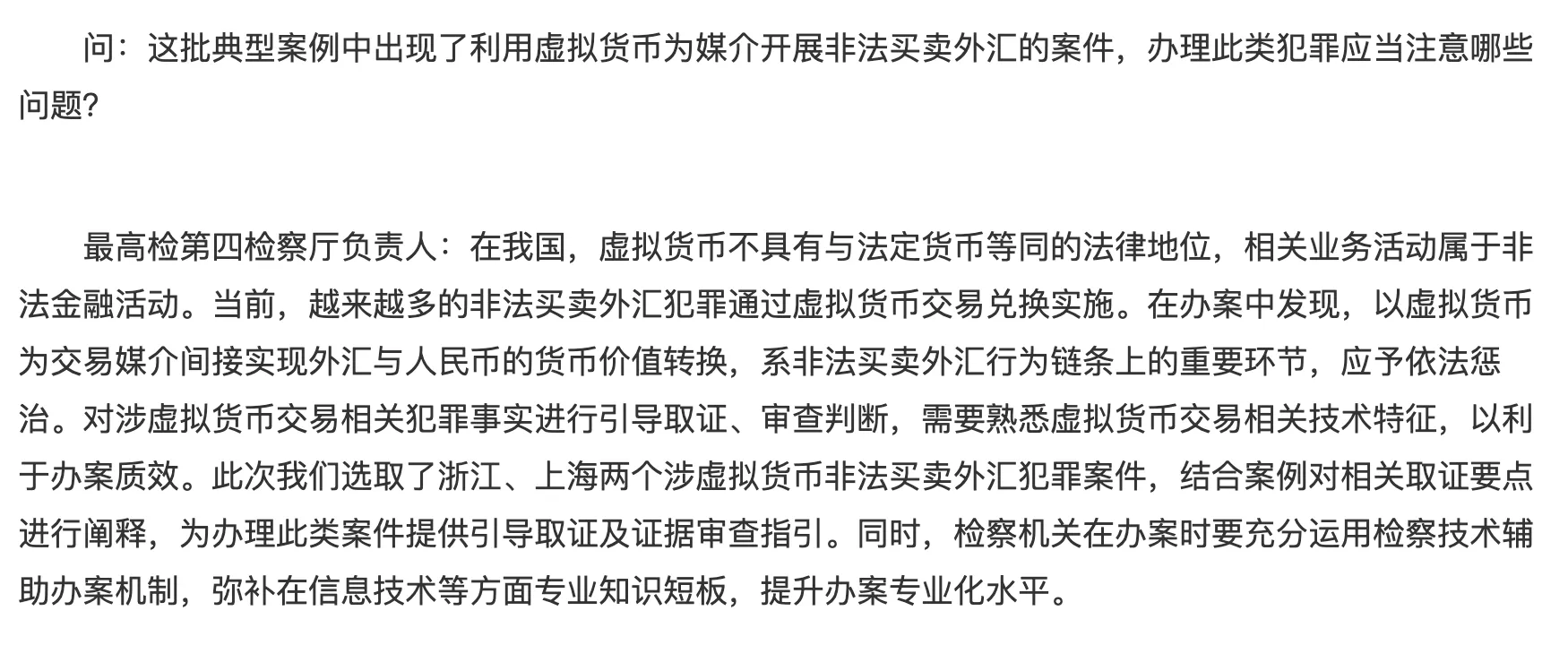
The legal line in that table comes from the People's Bank of China and seven other agencies' notice Yinfa [2026] No. 42 of February 6, 2026, which strictly prohibits exchange between fiat currency and virtual currency inside mainland China (PBoC). Chinese prosecutors go further and treat crypto conversion as part of illegal currency trading.
The penalties are not trivial. Under Article 45 of the foreign-exchange regulations, private or disguised buying and selling of foreign exchange can bring confiscation of gains and a fine of up to 30% of the amount, rising to between 30% and 100% in serious cases, with criminal liability on top (gov.cn). Those rules bind people in China, not you, but they explain why a supplier's account, an agent's accounts or the whole channel can stop working without notice. The frozen-account risk is covered in the risks to the buyer.
Rules in your own country on buying and sending crypto, and on documenting import payments, are separate. This is not legal advice; take local legal and tax advice before choosing a route.
Which route fits which situation
- Small tickets (a few thousand dollars). Fixed wire fees bite and USDT can look attractive. Small P2P conversions also tend to get worse prices, which narrows the gap.
- Large tickets (tens of thousands and up). Bank spreads usually tighten and the protections of a wire are worth more because more is at stake.
- First order with a new supplier. You know least about the counterparty, so recall rights, a verified payee and a clean paper trail matter most.
- "Cheaper" is not "lower risk." A route that saves 0.5% but leaves you with no recourse on a USD 50,000 order is a bet, not a saving.
Questions to ask a payment agent
- Which regulator licenses you, and what is the licence number?
- Will you identify me and ask about the underlying trade?
- What exact yuan amount will the supplier receive, and when?
- From which account, in whose name, will the supplier be paid?
- Do you use crypto anywhere in the chain?
- What happens if the payment is held or the receiving account is frozen?
If the agent cannot answer the first question or the answer to the fifth is yes, read the red flags before going further.
Frequently asked questions
Is USDT cheaper than a bank wire to China? Sometimes. It is cheaper to send, but the supplier converts at the P2P sell price, which can be below the bank rate. When USDT trades at a discount to the official rate, a wire often delivers more yuan.
How long does an international wire to China take? Many SWIFT payments arrive within a day, but payments into China can wait for document checks, Chinese bank holidays and time-zone cut-offs. Plan for one to several business days.
What do OUR, SHA and BEN mean on a wire form? They decide who pays bank charges: OUR means you pay all of them, SHA means you pay your bank and the beneficiary bears the rest, including intermediaries, and BEN means the beneficiary pays everything. Choose OUR if the invoice must arrive in full; banks often charge extra for it.
Are payment agents safer than paying in USDT? A licensed provider that pays through the banking system is a different product from USDT. An informal agent who pays yuan from personal accounts may be using USDT behind the scenes and carries the same risks.
Can I use the calculator for my own numbers? Yes. The hub calculator takes your invoice amount, wire fees, bank spread and USDT costs, and prices the USDT leg at the current P2P sell price for that size.
Sources
- State Council, Regulations of the People's Republic of China on Foreign Exchange Administration (revised 2008), Articles 12 and 45: https://www.gov.cn/zwgk/2008-08/06/content_1066085.htm
- Newburyport Bank, business fee schedule effective January 1, 2026: https://www.newburyportbank.com/wp-content/uploads/2026/03/NB-Fee-Schedule-Business-January-2026-1.pdf
- Bank of Scotland Business, international services rates and charges: https://business.bankofscotland.co.uk/business-home/rates-and-charges/international-services-rates-charges.html
- Swift, Swift GPI product page: https://www.swift.com/products/swift-gpi
- State Council General Office, 2026 public holiday schedule, published by Xinhua, November 4, 2025: https://www.news.cn/politics/20251104/88bcffd88ae249e58c699b8772548e3d/c.html
- People's Bank of China et al., Yinfa [2026] No. 42, February 6, 2026: https://www.pbc.gov.cn/tiaofasi/144941/3581332/2026020619591971323/index.html
- China Daily, SPP and SAFE officials on typical foreign exchange crime cases, December 27, 2023: https://cn.chinadaily.com.cn/a/202312/27/WS658b9022a310c2083e414bdd.html